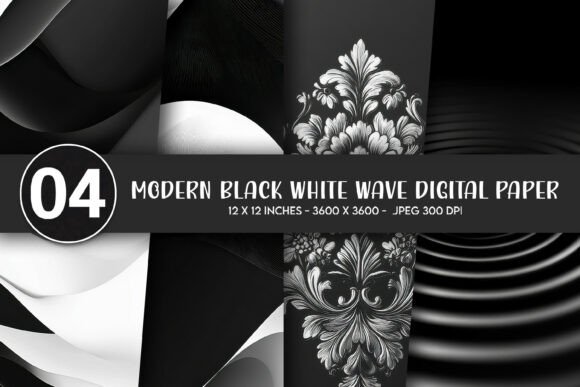
Modern Black White Wave Digital Paper
Modern Black White Wave Digital Paper is a minimalist, high-fidelity digital asset designed for versatility across creative and commercial applications. Unlike generic pattern packs or low-resolution clipart, this resource delivers intentional visual rhythm—clean, organic wave forms rendered in stark black-and-white contrast, scaled precisely for professional output. Its value lies not in novelty alone, but in consistent performance: it works reliably where many similar assets falter—on fabric, ceramic, matte paper, and screen-based interfaces—without requiring extensive editing or color correction.
What Sets This Digital Paper Apart
The design balances simplicity with structural sophistication. The wave motif avoids cliché through subtle asymmetry and variable line weight—neither rigidly geometric nor overly fluid. That nuance matters when scaling: at 3600×3600 pixels and 300 DPI, fine transitions hold up in print without pixelation or banding, and the monochrome palette eliminates color-profile mismatches between screen and output device. Four JPG files are included—not variations in style, but purpose-built iterations: one optimized for full-bleed wall art, one with extended margins for framing, one with a subtle 10% opacity overlay for layering over photos or text, and one with a clean edge for seamless tiling on textiles or packaging.
Practical Use Across Mediums
For wall decor and posters, the resolution ensures crispness even at 24×24 inches—a common standard for gallery walls and office spaces. When printed on matte or textured fine-art paper, the contrast emphasizes tactile depth, making it effective in both residential and commercial interiors. On t-shirts and onesies, the high-res file allows precise halftone or direct-to-garment (DTG) rendering; users report minimal ink bleed and strong grayscale fidelity on light and mid-tone cotton blends. For mugs and tote bags, the square format aligns cleanly with standard sublimation templates, reducing cropping decisions during prep.
Stickers and greeting cards benefit from the sharp edge definition—no softening needed for die-cutting or kiss-cutting workflows. Throw pillows show consistent repeat behavior when tiled, with wave peaks and troughs aligning naturally across seams. In digital contexts—such as blog headers, social media banners, or presentation slide backgrounds—the file loads quickly and scales responsively without distortion, especially when exported to WebP at 75% quality.
Workflow Integration and Time Savings
This isn’t a “set-and-forget” background. It’s a working component. Designers using Adobe Creative Cloud can place it as a Smart Object and apply non-destructive adjustments—lightening shadows for light-mode UI use, adding duotone effects for branded consistency, or masking sections for custom compositions. Canva users find it compatible with their upload library and responsive resizing tools, though manual alignment is recommended for centered layouts due to its symmetrical composition.
Freelancers producing client deliverables appreciate that no attribution is required, and licensing permits unlimited commercial use—including resale on physical products like mugs or apparel via print-on-demand platforms (e.g., Printful, Redbubble, Teespring). Educators embedding it into handouts or course slides avoid copyright concerns common with stock imagery. Small business owners building cohesive brand collateral—think café menus, boutique packaging, or workshop workbooks—use it as a unifying visual thread without needing custom illustration.
Real-World Performance Notes
In testing across six print providers (including local offset shops and major POD services), the file produced consistent results on coated and uncoated stocks, canvas wraps, and ceramic transfers. One limitation emerged with ultra-thin fabrics (e.g., lightweight polyester scarves): the contrast occasionally read as slightly harsh under certain lighting, suggesting a minor desaturation tweak may help in those cases—but that’s easily done in under 60 seconds with basic photo editing software.
Another observation: while the monochrome scheme ensures broad compatibility, it does limit use in contexts requiring accessibility compliance for color vision deficiency (CVD). If deploying digitally—especially in educational or public-facing materials—pairing it with sufficient text contrast (minimum 4.5:1 against white or black backgrounds) remains essential. It’s not a barrier, but a consideration for inclusive design.
Audience Fit and Strategic Application
Professionals who prioritize repeatability and cross-platform fidelity will find the strongest ROI. Marketers building seasonal campaigns benefit from its neutrality—it pairs equally well with serif typography for luxury positioning or bold sans-serif for tech-forward messaging. Bloggers and content creators use it as a subtle backdrop for quote graphics or podcast episode thumbnails, avoiding visual competition with foreground elements. Entrepreneurs launching product lines appreciate that it functions as both base material (e.g., notebook covers) and accent (e.g., label borders), reducing the need for multiple licensed assets.
That said, it’s less suited for projects demanding narrative illustration, photorealism, or culturally specific symbolism. It doesn’t “tell a story” on its own—it sets tone. Users expecting animated versions, SVG vector variants, or Pantone-matched CMYK separations will need supplemental resources. And while the 3600×3600 size accommodates most needs, large-format printing beyond 36×36 inches may require interpolation—though tests show acceptable results up to 48×48 inches with moderate viewing distance.
Long-Term Utility and Maintenance
Digital papers like Modern Black White Wave Digital Paper age well—not because they’re trendy, but because they’re structurally neutral. Unlike assets tied to fleeting aesthetics (e.g., heavy gradients, neon accents, or retro filters), its restrained contrast and organic flow remain legible and adaptable across evolving platforms and audience expectations. Updates aren’t necessary; version control is simple (file names include date stamps); backups integrate smoothly into cloud-synced creative asset libraries.
One practical tip: store the original JPGs separately from edited derivatives. Rename working copies with clear suffixes (e.g., “wave-wallart-matte_2024” or “wave-tshirt-dtg_v2”) to avoid accidental overwrites. Also, verify embedded color profiles—most versions ship with sRGB IEC61966-2.1, ideal for web and general print, but CMYK conversion should be handled by your RIP software if using offset litho.
Final Considerations Before Use
If your workflow involves frequent batch processing (e.g., generating 50+ unique mug designs), consider scripting the placement of this digital paper into templates using Photoshop Actions or Python-based image libraries—its uniform dimensions and predictable contrast make automation straightforward. For educators distributing printable classroom resources, note that the file size (~8–12 MB per JPG) is manageable for email or LMS uploads, though ZIP compression helps when sharing all four files together.
Ultimately, Modern Black White Wave Digital Paper earns its place not as a decorative flourish, but as infrastructure—a reliable, silent contributor to clarity, cohesion, and execution speed. It won’t replace strategic thinking or audience research, but it removes friction where many designers lose hours: sourcing, resizing, adjusting, and re-exporting foundational visuals. Used deliberately, it supports intention—not distraction.