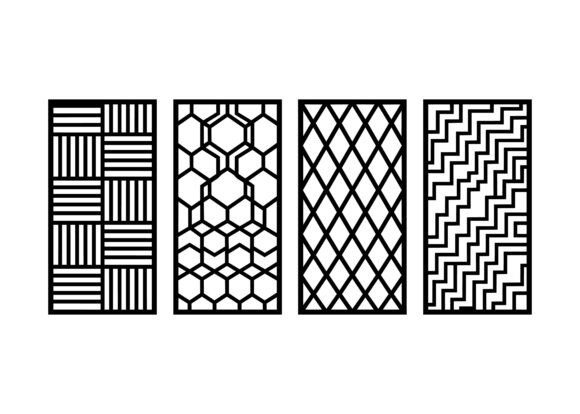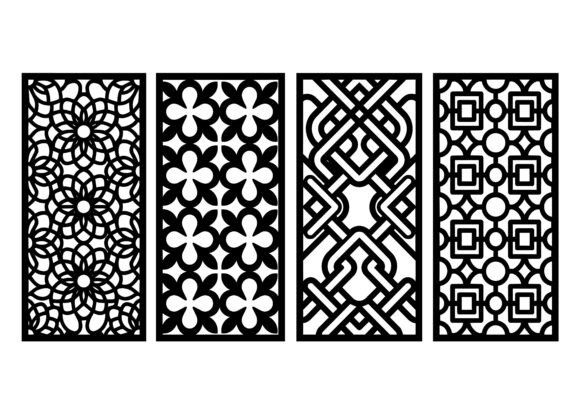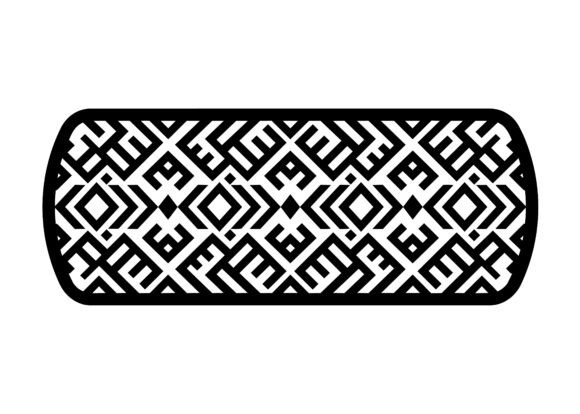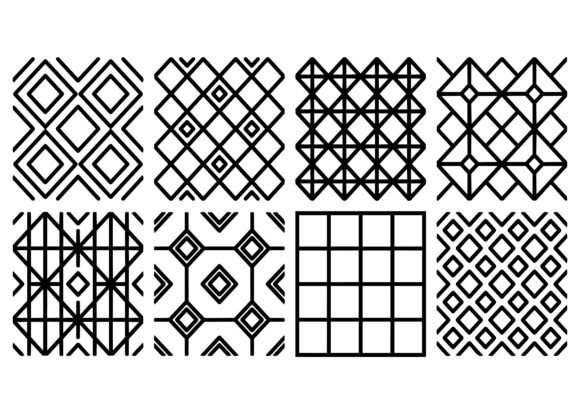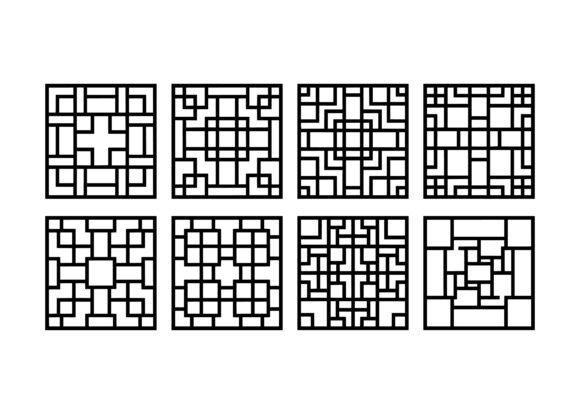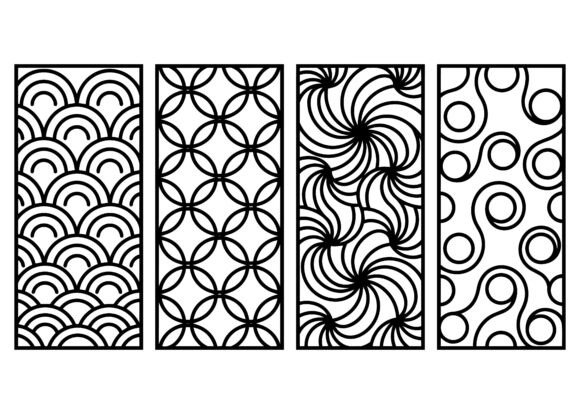
Geometric Seamless Pattern Panel EPS
Geometric Seamless Pattern Panel EPS is a precision-crafted collection of vector-based repeating designs—arches, circles, spirals, and radial forms—built to tile flawlessly across any surface. Unlike raster graphics or loosely constructed motifs, these patterns are mathematically aligned, with smooth, consistent vector lines that retain clarity at any scale. They’re not just decorative; they’re engineered for function: optimized for laser cutting, CNC engraving, vinyl plotting, and digital fabrication workflows.
What sets this resource apart isn’t just aesthetics—it’s intentionality. Each pattern panel balances visual rhythm with structural integrity. Lines meet cleanly. Gaps and overlaps are eliminated. Spacing is calibrated for material behavior—whether you’re scoring thin birch plywood, etching stainless steel, or printing on woven linen. That level of technical discipline makes Geometric Seamless Pattern Panel EPS unusually versatile across disciplines and skill levels.
Where These Patterns Deliver Real Value
Designers use them to accelerate surface development—skipping months of manual tiling and alignment work. Educators integrate them into STEAM workshops to demonstrate symmetry, tessellation, and vector mathematics in tangible ways. Small business owners apply them directly to product lines: custom room dividers, branded retail displays, or limited-run textile collections. Even hobbyists find immediate utility—no design software expertise required to import, scale, and cut.
The EPS format ensures compatibility with industry-standard tools like Adobe Illustrator, CorelDRAW, and Inkscape. Because EPS is resolution-independent, a 2-inch motif scales cleanly to a 12-foot wall panel without pixelation or distortion. No re-rasterizing. No quality loss. Just plug-and-play scalability.
Creative Applications Across Materials & Contexts
Wall panels and architectural screens: Use radial spiral layouts to create dynamic light-filtering partitions. A tightly spaced arch pattern in matte black acrylic produces subtle shadow play when backlit—ideal for café interiors or boutique retail spaces. For woodworkers, open negative-space circle arrays translate beautifully into CNC-cut room dividers with acoustic diffusion properties.
Textiles and soft goods: While EPS isn’t native to textile design software, it exports effortlessly to PDF or SVG—formats widely supported by fabric printers (like Spoonflower or Printful). A low-contrast spiral repeat in charcoal and oat works as a refined upholstery motif; a bold concentric circle layout adds graphic energy to tote bags or pillow covers.
Paper crafts and stationery: Laser-cut greeting cards, layered invitations, or modular packaging templates benefit from clean vector edges. Try nesting three scaled versions of the same spiral pattern to build dimensional pop-up elements—no registration errors, no jagged cuts.
Branding and marketing assets: Rather than defaulting to stock photography or generic gradients, embed a subtle geometric panel as a background texture in pitch decks, social media banners, or email headers. A muted arch motif in brand-aligned tones reinforces visual consistency without competing with content.
Adapting for Different Audiences & Goals
- Freelancers and agencies: Keep a master library of 5–7 core Geometric Seamless Pattern Panel EPS files—each with distinct density and rhythm. Swap them in during early mockups to test how pattern weight affects hierarchy and readability. A tight circle grid may overwhelm body text; a wide-spaced arch layout provides breathing room.
- Educators: Isolate one element—say, the spiral—and ask students to modify stroke weight, spacing, or rotation increment. Then compare how those small changes impact perceived motion, balance, or repetition fatigue. It’s applied geometry with immediate visual feedback.
- Hobbyists and makers: Start with the simplest radial form. Cut it from 1/8" basswood using a diode laser, then stain and mount it over painted drywall. The contrast between handmade warmth and precise geometry creates quiet sophistication—no gallery wall required.
- Small manufacturers: Load the EPS into your CAM software and run test cuts on scrap material first. Note kerf compensation needs per substrate—acrylic behaves differently than MDF. Once dialed in, batch production becomes predictable and repeatable.
Maintaining Clarity and Consistency
Even powerful tools can produce cluttered results if used without restraint. To keep outcomes effective:
- Limit color variation. Most Geometric Seamless Pattern Panel EPS files are built in single-line or two-tone configurations. Adding more colors mid-process often dilutes impact—especially in physical applications where registration accuracy matters.
- Respect scale context. A dense spiral panel reads as texture at 3 feet—but becomes dizzying at arm’s length. Test print or cut a 6"x6" sample before committing to full-scale output.
- Anchor with neutral space. Let the pattern breathe. Pair it with ample margin, solid-color borders, or unadorned adjacent surfaces. Repetition gains strength through contrast—not saturation.
- Document your adaptations. If you adjust spacing, rotate elements, or combine two panels, save the modified version with a clear name (e.g., “Arch_Spiral_Hybrid_12ptSpacing”). Future you will thank present you.
These patterns don’t demand stylistic allegiance. They support minimalism, industrial grit, Scandinavian calm, or even playful maximalism—depending on how you frame, scale, and finish them. A brushed-metal wall panel with a fine radial grid feels quietly authoritative. The same grid, cut from translucent polycarbonate and edge-lit, becomes ethereal. The vector foundation stays constant; the interpretation shifts with intent.
What matters most isn’t owning every variation—but knowing which one solves your current problem. Is it about speed? Precision? Texture? Brand cohesion? Material compatibility? Geometric Seamless Pattern Panel EPS answers several of those questions at once—without requiring new software, subscriptions, or design training. It meets creators where they are, then supports them moving forward—cleanly, consistently, and without compromise.