Classic Train Engine
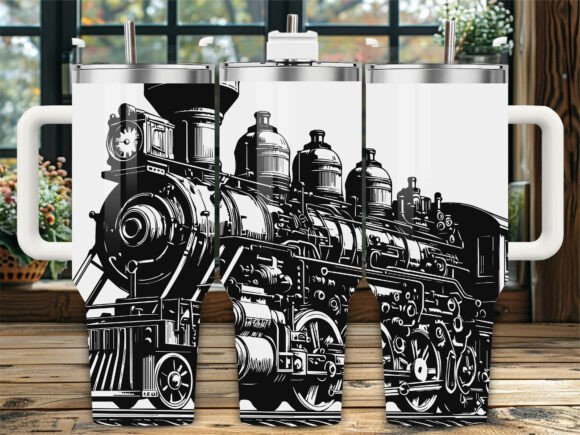
The Classic Train Engine design is a meticulously crafted, full-wrap laser tumbler wrap built for precision, consistency, and professional output. It’s not just an image—it’s a production-ready asset engineered to integrate seamlessly into your laser engraving workflow. Whether you’re producing branded tumblers for client projects, launching a small-batch merchandise line, or personalizing gifts with vintage charm, this design delivers clean vector geometry, calibrated spacing, and scalable fidelity across common tumbler diameters.
Designed from the ground up for laser systems—not screen display—the Classic Train Engine file set includes SVG, EPS, PDF, and PNG formats. Each version serves a distinct role in your process: SVG and EPS preserve vector integrity for infinite resizing without pixelation; PDF ensures reliable print and preview compatibility across platforms; PNG provides a high-resolution raster reference for alignment checks or mockup integration. All files are pre-optimized—no unnecessary layers, embedded fonts, or hidden objects—so your laser software reads them cleanly, reducing setup time and minimizing engraving errors.
How It Fits Into Your Production Workflow
You don’t add Classic Train Engine at the end of a project—you build around it. Its value emerges early in planning: when selecting tumbler brands (e.g., YETI, Ozark Trail, Simple Modern), you use the included dimensions guide to determine which size variant best matches your target vessel’s circumference and height. That decision informs your machine settings *before* you load the file—avoiding mid-process recalibration or cropped engraving.
During preparation, the design supports consistency across batches. If you’re fulfilling orders for a school fundraiser or corporate team event, having one trusted, tested wrap means every tumbler carries identical visual weight and alignment. No manual adjustments per unit. No guesswork on rotation or seam placement. The file includes subtle registration marks and centerlines—visible only in vector editors—that help you verify orientation before sending to the laser controller.
After engraving, the result reflects intentional design discipline: crisp linework, balanced negative space, and proportional scaling that honors the locomotive’s heritage details—smokestacks, riveted boiler plates, and cab windows—all while maintaining legibility at 2x–3x magnification under standard lighting. That fidelity isn’t accidental. It’s the outcome of deliberate stroke-width calibration and path simplification, optimized for CO₂ and diode lasers operating between 10–60W power ranges.
Integration With Common Tools and Platforms
Classic Train Engine works where you do. In LightBurn, import the SVG directly—its paths auto-convert to cut/engrave layers with no cleanup needed. In RDWorks or LaserGRBL, open the EPS or PDF to retain vector accuracy during scaling. For users managing inventory or fulfillment via Shopify or Square, the PNG version serves as a consistent product thumbnail—ensuring what customers see online matches the physical output precisely.
It also pairs naturally with companion assets. Pair it with a minimalist “Est. 1923” monogram SVG for dual-side branding, or layer it beneath a custom name or date stamp using offset alignment guides already embedded in the file. Because all elements share the same coordinate origin point, stacking remains predictable—even when resizing across multiple tumbler models.
Practical Implementation Tips
- Always test first. Run a low-power engraving pass on scrap stainless steel or a spare tumbler to verify depth, contrast, and seam alignment. Engraving speed, air assist, and focal distance vary by machine—what works on your friend’s K40 may need adjustment on your xTool D1 Pro.
- Resize intelligently. Don’t stretch the design horizontally. Instead, scale uniformly using the original aspect ratio, then adjust your laser’s job origin to match the tumbler’s physical seam location. Most modern controllers allow offset input—use it to center the engine’s front axle over the cup’s natural grip zone.
- Organize for repeatability. Save your final scaled version as a new file (e.g., “ClassicTrain_YETI_Rambler_20oz_v2”) with notes on power/speed settings. This builds a reusable library—not just for this design, but as a template for future wraps.
- Check material prep. A clean, oil-free tumbler surface ensures even laser absorption. Wipe with isopropyl alcohol before loading—especially after handling, as fingerprints can cause inconsistent engraving depth along curved surfaces.
Why Compatibility and Preparation Matter
Laser engraving isn’t plug-and-play—it’s a feedback loop between file, machine, material, and operator. The Classic Train Engine design anticipates those variables. Its paths are closed, non-overlapping, and use minimal anchor points—reducing processing lag in older controllers. Stroke widths stay above 0.05mm to prevent dropout on fine details like piston rods or ladder rungs. Even the color palette is functional: black vector paths translate reliably to grayscale engraving maps, eliminating color-profile mismatches that plague RGB-based artwork.
Preparation extends beyond the file. Knowing your tumbler’s exact diameter (not just its marketing name) matters—Ozark Trail 20 oz and 30 oz tumblers share similar heights but differ in circumference by ~12mm. That variance shifts seam placement by nearly half an inch. The Classic Train Engine package includes a quick-reference chart mapping common models to recommended scale percentages, saving time and material waste.
Long-Term Use and Quality Control
This isn’t disposable art. You’ll return to Classic Train Engine across seasons, clients, and product iterations. Its durability comes from simplicity: no gradients, no embedded images, no font dependencies. Every element is native vector—editable, measurable, and reproducible years later, even if your software updates or hardware changes.
For quality control, establish a three-point check before each batch: (1) Confirm file units match your laser’s expected input (mm vs. inches); (2) Verify the engraved seam aligns visually with the tumbler’s base weld line—not just the top rim; (3) Inspect edge continuity where the wrap meets itself—no visible gaps or overlaps. These steps take under 90 seconds but prevent rework on 50+ units.
What This Means for Your Work
If you’re a small business owner batching holiday orders, Classic Train Engine shortens your average order-to-ship time by removing design iteration from the equation. If you’re an educator running a STEM workshop on manufacturing tech, it becomes a teaching artifact—demonstrating how vector precision translates to real-world output. If you’re a freelancer building a portfolio of branded merchandise, it’s a repeatable differentiator: clients recognize your consistent finish, not just your logo placement.
It doesn’t replace judgment—it sharpens it. When you know the file behaves predictably, your attention shifts to higher-value decisions: Which tumbler finish best complements the engraving contrast? How does lighting in the client’s office affect perceived detail? Should you add a matte sealant for outdoor durability? Those are the questions worth your time—not troubleshooting misplaced anchor points or clipped paths.
The Classic Train Engine design succeeds because it respects your process. It assumes you’ve already chosen your tools, calibrated your machine, and understand your material limits. It meets you there—not as a shortcut, but as a foundation you can rely on, refine, and scale without second-guessing the basics.