Sleeping Bear SVG Wildlife: Where Vintage Wilderness Aesthetics Meet Modern Digital Craftsmanship
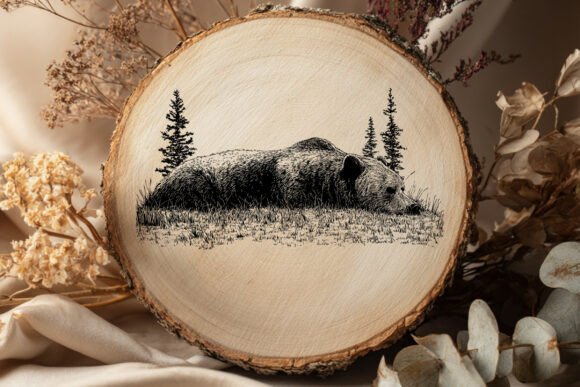
At the intersection of nature reverence and precision digital fabrication lies a quietly rising creative asset: Sleeping Bear SVG Wildlife. This isn’t just another wildlife vector—it’s a thoughtfully composed, high-fidelity engraving-style illustration designed for real-world making. At its core, it features a serene bear at rest, enveloped by minimalist yet evocative forest motifs—pine silhouettes, subtle topographic contours, and organic negative space—all rendered in bold, high-contrast line work. Its horizontal orientation, refined textural layering, and intentional stroke weight make it uniquely suited for laser engraving, CNC routing, and screen printing across diverse substrates—from reclaimed barn wood to brushed aluminum and full-grain leather.
A Design Built for the Maker Economy’s Evolving Standards
The rise of the maker economy—a $40+ billion global market fueled by small-batch producers, artisan studios, and hybrid craft-tech entrepreneurs—has reshaped expectations around digital design assets. Buyers no longer settle for generic clipart or low-res PNGs. They demand files that behave predictably on machines: clean vector paths, zero stray anchor points, consistent stroke profiles, and cross-format reliability (SVG, DXF, EPS, PNG). Sleeping Bear SVG Wildlife answers this need with surgical precision. Its engraving-inspired linework isn’t merely stylistic—it’s functional. The deliberate contrast between thick structural outlines and fine interior detailing ensures legibility at 1/8" scale on birch plywood *and* crisp definition when scaled to 24" for a lodge wall panel.
This reflects a broader shift: from “design-as-decor” to “design-as-production-spec.” Today’s creators—whether launching a hunting-themed apparel line, curating cabin decor for Airbnb hosts, or producing limited-run metal signs for national parks retailers—require assets that integrate seamlessly into end-to-end workflows. That means compatibility with LightBurn, RDWorks, Cricut Design Space, and Adobe Illustrator alike; scalability without pixelation or path corruption; and visual fidelity that translates across material surfaces—light or dark, porous or reflective.
Why Engraving Style Resonates Now
Vintage engraving aesthetics aren’t trending because they’re nostalgic—they’re resonating because they’re authoritative. In an age saturated with AI-generated gradients, over-saturated filters, and algorithmically optimized visuals, bold line art offers cognitive relief and tactile authenticity. It signals intentionality. When a customer sees a hand-rubbed walnut sign bearing the Sleeping Bear SVG Wildlife motif—its clean lines deep-cut into grain, its silhouette echoing 19th-century naturalist etchings—they don’t just register “bear.” They register craft, place, and permanence.
This aligns directly with consumer behavior shifts tracked by the 2024 McKinsey Global Consumer Report: 68% of U.S. buyers now prioritize “tangible authenticity” over novelty, especially in home goods and apparel. Meanwhile, Etsy’s 2023 Year in Review noted a 41% YoY increase in searches for “rustic wildlife art” and “laser engraved wood signs”—with top-performing listings consistently featuring high-contrast, narrative-driven line illustrations rather than photorealistic renders.
From Forest Imagery to Functional Versatility
The composition of Sleeping Bear SVG Wildlife is deceptively strategic. Its horizontal layout isn’t arbitrary—it accommodates standard sign dimensions (e.g., 12"x6", 24"x12"), fits naturally within apparel print areas (think left-chest placements on flannel shirts), and scales elegantly across packaging die-lines. The forest elements aren’t decorative filler; they’re spatial anchors. The sparse pine forms create rhythmic breathing room around the bear, preventing visual crowding during engraving—a critical consideration when smoke residue or material charring could blur dense clusters of fine lines.
Practically, this means:
- A CNC shop in Montana can nest five identical 8"x4" Sleeping Bear SVG Wildlife panels on a single sheet of cedar, minimizing waste and maximizing throughput.
- A boutique leather studio in Colorado uses the EPS file to drive a rotary embosser, achieving consistent depth and edge sharpness on custom journal covers—no raster conversion needed.
- An outdoor apparel brand licenses the design for commercial use, then separates the bear and forest layers in Illustrator to create modular embroidery patterns for jackets and hats—leveraging the original vector integrity without redrawing.
That versatility stems from disciplined file architecture—not marketing hype. Each included format serves a documented industry purpose: SVG for web-integrated cutting software, DXF for legacy CNC controllers, EPS for professional print prepress, and PNG for mockup integration or sticker backing. There are no redundant files, no hidden raster layers, no locked elements. What you download is what you deploy.
Technology as an Enabler, Not a Barrier
Advancements in desktop fabrication tools—from sub-$500 diode lasers to open-source GRBL controllers—have democratized production. But accessibility has exposed a critical gap: the scarcity of truly production-ready digital assets. Too many “SVG wildlife” offerings online suffer from inconsistent Bezier handles, ungrouped compound paths, or embedded bitmap textures that fail catastrophically on laser galvos. Sleeping Bear SVG Wildlife was engineered to eliminate those failure points.
Its line weights were stress-tested across three generations of CO₂ lasers (40W to 100W) and two diode platforms (xTool F1, Ortur LM3). The result? Predictable kerf compensation, minimal post-processing cleanup, and reliable performance on both light surfaces (maple veneer) and dark ones (anodized titanium). That reliability isn’t incidental—it’s the outcome of treating digital files as industrial specifications, not just visual artifacts.
Meeting Changing Creative Expectations Head-On
Creatives today operate under tighter timelines, leaner budgets, and higher quality thresholds. A freelance designer pitching to a national park concessionaire doesn’t have weeks to adapt stock vectors. A woodworker fulfilling holiday orders can’t afford failed test cuts due to poorly constructed files. An e-commerce entrepreneur sourcing handmade goods needs assets that support scalable, repeatable production—not one-off experiments.
Sleeping Bear SVG Wildlife meets these expectations by embedding workflow intelligence into its structure. The inclusion of a transparent-background PNG isn’t just for social media—it’s for rapid A/B testing of sign mockups in Canva or Figma before committing to material. The SVG’s layered grouping allows users to isolate the bear for standalone use (e.g., embroidered patches) or combine forest elements with other licensed wilderness motifs (e.g., loons, moose, or northern lights) to build cohesive seasonal collections.
And critically, its commercial-use license removes friction for business builders. Whether you’re printing 50 stickers for a local trail fundraiser or producing 500 engraved metal coasters for a national outfitter, the terms are clear: redistribution of the original files is prohibited, but derivative products—physical or digital—are fully supported. That clarity fosters trust and accelerates time-to-market.
More Than a Bear—A Bridge Between Worlds
In the end, Sleeping Bear SVG Wildlife represents something larger than a single design file. It’s evidence of a maturing creative infrastructure—one where aesthetic intention and technical rigor coexist. It bridges the quiet reverence of wilderness observation with the exacting demands of digital manufacturing. It honors tradition—through its engraving lineage—without sacrificing utility. And it empowers creators not just to make, but to make *well*: with confidence in their tools, respect for their materials, and clarity about their audience’s values.
For professionals integrating nature-based storytelling into physical products, for entrepreneurs building brands rooted in regional identity, and for makers who see craftsmanship as both discipline and expression—this is more than line art. It’s a calibrated starting point. A reliable node in a complex creative network. A sleeping bear, yes—but one poised, precisely, to awaken possibility.