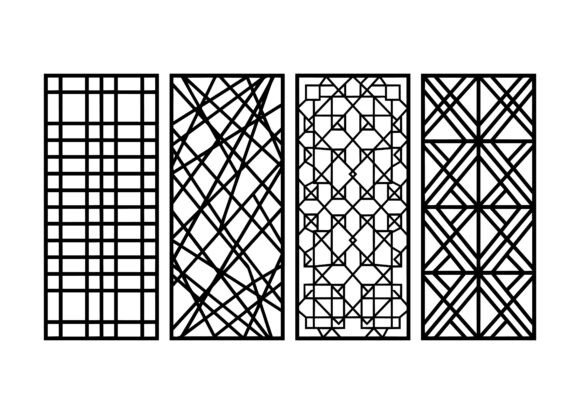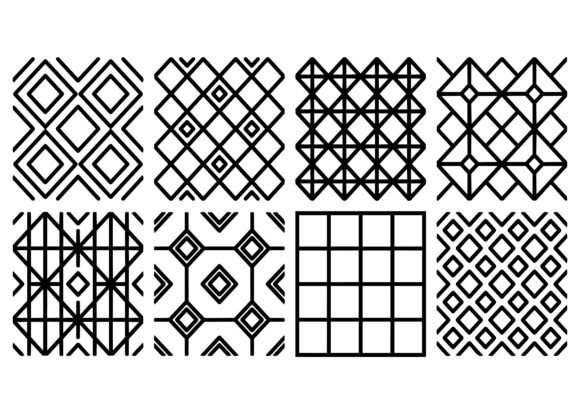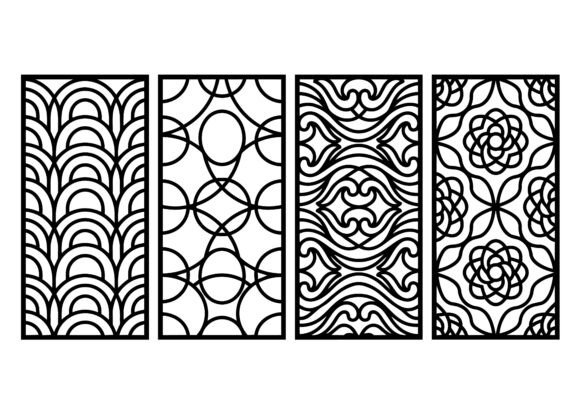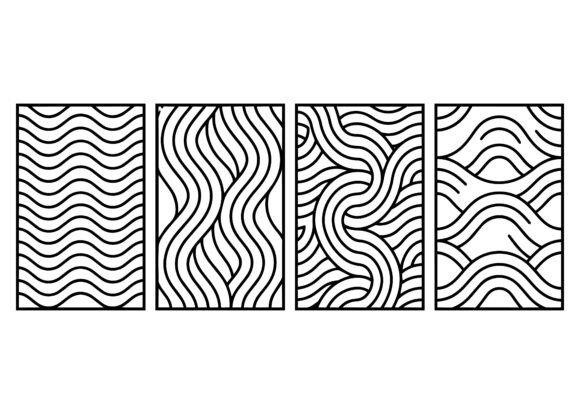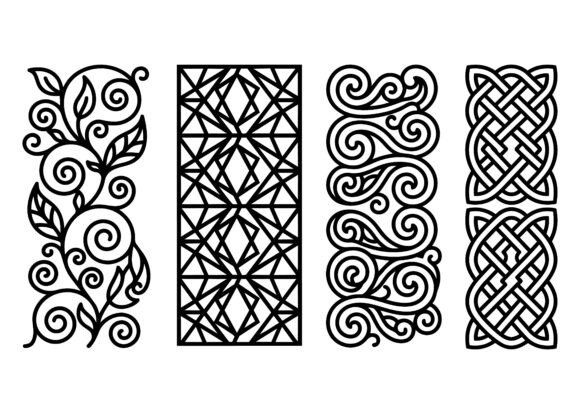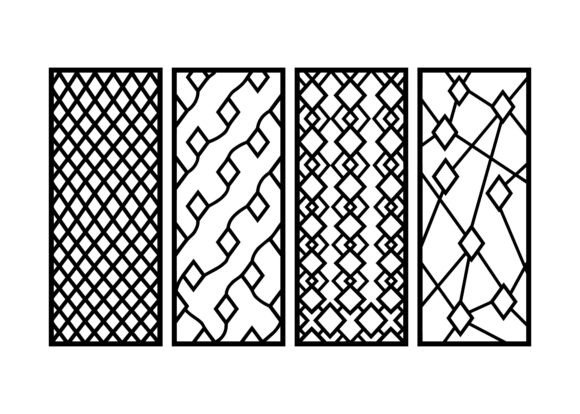
Abstract Diamond Grid Pattern EPS Bundle
Designers, makers, and product developers increasingly need assets that bridge digital precision with physical execution—assets that work as well on a laser-cut walnut screen as they do on a silk scarf or a branded retail display. The Abstract Diamond Grid Pattern EPS Bundle meets that need directly: a curated collection of modern decorative panels built from lattice grids, flowing line compositions, structured diamond repeats, and interconnected geometric layouts—all delivered in high-fidelity EPS format.
Unlike raster-based patterns or low-resolution downloads, this bundle is engineered for real-world fabrication. Every line is clean, intentional, and mathematically precise—no anti-aliasing artifacts, no pixelation, no guesswork. That means when you scale a diamond repeat to cover a 12-foot wall panel or reduce it to fit a business card border, the geometry holds. No distortion. No reworking.
Why Vector Precision Matters More Than Ever
Today’s creative workflows are hybrid by necessity. A textile designer may start in Illustrator, send files to a digital print house, then collaborate with a seamstress who needs clear seam allowances and grain alignment. An interior architect might layer a diamond grid over CAD drawings before routing it into reclaimed oak using CNC. A packaging engineer could adapt the same pattern across corrugated cardboard, aluminum foil stamping, and embossed paperboard—all requiring different line weights, tolerances, and nesting logic.
The Abstract Diamond Grid Pattern EPS Bundle supports those transitions because EPS remains one of the most universally accepted vector formats across fabrication software—from CorelDRAW (still widely used in sign shops and laser studios) to Adobe Creative Cloud, AutoCAD-compatible workflows, and even newer cloud-based CAM platforms. Its backward compatibility ensures your files open reliably, whether you’re working on a 2020 MacBook or a Windows workstation running legacy engraving drivers.
From Wallpaper to Wearables: Where These Patterns Live Now
Geometric abstraction isn’t trending—it’s settling in as foundational visual language. You see it in hospitality spaces where perforated metal screens diffuse light without blocking airflow; in athleisure brands using subtle diamond motifs to suggest structure and motion; in sustainable packaging where minimalist lattice patterns replace heavy ink coverage, reducing material waste and improving recyclability.
What makes the Abstract Diamond Grid Pattern EPS Bundle especially relevant here is its intentional versatility. It doesn’t force a single aesthetic. One layout might emphasize rhythm and repetition—ideal for acoustic wall panels that need consistent perforation density. Another leans into asymmetry and layered line weight—perfect for fashion tech prototypes where conductive thread pathways follow geometric logic. A third uses open negative space and balanced stroke contrast—suited for die-cut labels on glass bottles or ceramic mugs where ink adhesion and edge clarity matter.
This isn’t decoration for decoration’s sake. It’s design infrastructure—modular, adaptable, and rooted in function.
How Material Choice Shapes Pattern Use
Not all materials behave the same way under tool paths or print processes—and the Abstract Diamond Grid Pattern EPS Bundle anticipates that. Each pattern is built with fabrication constraints in mind:
- Wood and acrylic: Line spacing and stroke width account for kerf—the material lost during laser cutting. Patterns avoid hairline gaps that would collapse or char at small scales.
- Metal: Repeats include buffer zones between elements to prevent thermal distortion during etching or waterjet cutting. No overlapping anchor points that could cause burring.
- Fabric: Flowing line compositions use continuous paths rather than fragmented segments, supporting seamless screen printing and minimizing registration errors on stretchy substrates.
- Packaging: Some layouts include built-in bleed and trim guides, aligning with standard dieline conventions for folding cartons and rigid boxes.
This level of material-aware design saves time—not just in file prep, but in prototyping rounds. One furniture maker reported cutting development time in half after switching from custom-drawn patterns to this bundle, simply because stroke consistency eliminated trial-and-error adjustments in their laser control software.
Real Workflows, Not Just Inspiration
Consider a small-batch homeware brand launching a new line of room dividers. They need patterns that feel cohesive across three materials—walnut veneer, powder-coated steel, and woven polyester mesh. Instead of commissioning separate illustrations for each, they license the Abstract Diamond Grid Pattern EPS Bundle, then adjust color palettes, line weights, and repeat densities per substrate—not redrawing from scratch.
Or take an educator teaching digital fabrication to design students. Rather than spending class time troubleshooting distorted SVG imports or mismatched units, they use the EPS files as stable starting points for lessons on nesting optimization, toolpath simulation, and material testing. Students learn principles—not just software shortcuts.
Even marketers benefit indirectly. When a product’s surface treatment uses a recognizable, scalable pattern—like a refined diamond grid—it becomes part of the brand’s tactile signature. That consistency strengthens recognition across touchpoints: a website hero image, a pop-up shop wall, and the unboxing experience all echo the same geometry. No style guide needed—just intelligent asset reuse.
Evolving Beyond Ornamentation
Historically, grid-based patterns served decorative or symbolic roles—think Islamic tilework or mid-century textile prints. Today, they’re gaining functional weight. In architecture, lattice structures improve thermal performance and solar shading. In industrial design, repeating diamond forms distribute stress evenly across load-bearing surfaces. Even in UI, subtle background grids support responsive layout systems—though that’s outside this bundle’s scope.
The Abstract Diamond Grid Pattern EPS Bundle reflects that shift. Its compositions aren’t static—they’re frameworks. A “structured diamond repeat” can become a modular tile system for floor inlays. An “interconnected geometric layout” can serve as a base map for circuit board traces or irrigation channel planning. The files don’t prescribe use; they enable translation.
Commercial Readiness Without Compromise
Licensing matters—especially when output affects revenue. This bundle includes full commercial rights: no attribution required, no usage caps, no restrictions on end products. Whether you’re producing 50 limited-edition scarves or licensing the pattern to a global home goods retailer, the legal foundation is clear and straightforward.
And because it’s delivered in EPS—not AI, not PDF, not PNG—the files retain editable vector data across platforms. Designers can ungroup elements, recolor strokes, adjust spacing, or isolate sections for masking—all without losing fidelity. There’s no hidden raster layer, no embedded font dependency, no proprietary compression.
That reliability reduces friction at every stage: client handoff, vendor submission, version control, and archive preservation. One freelance surface designer noted she now stores these EPS files alongside her master color swatches and material spec sheets—treated not as “graphics,” but as core production assets.
A Practical Next Step
If you regularly work across physical and digital outputs—or if your team juggles multiple materials, tools, and stakeholders—the Abstract Diamond Grid Pattern EPS Bundle functions less like a download and more like infrastructure. It’s not about adding flair. It’s about removing friction between idea and execution.
You don’t need to overhaul your process to benefit. Start small: replace one manually drawn repeat in an upcoming packaging project. Test a lattice grid on a sample acrylic panel. Use a flowing line composition as a base for a custom embroidery digitizing job. See how much time you save on file prep—and how much more confidently you can propose cross-material solutions to clients.
In a landscape where speed, consistency, and scalability are non-negotiable, having a set of rigorously built, fabrication-ready patterns isn’t a luxury. It’s practical leverage.