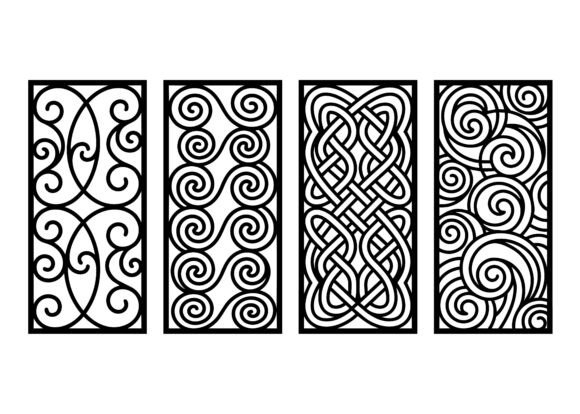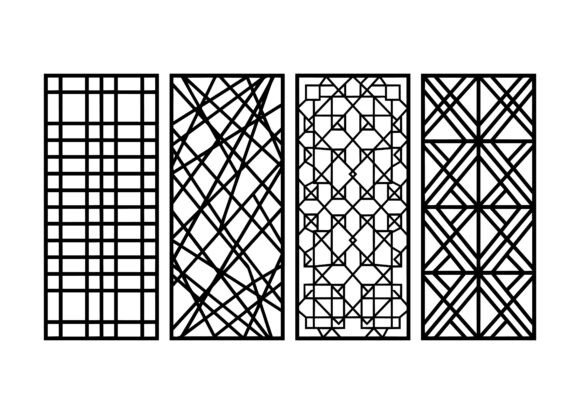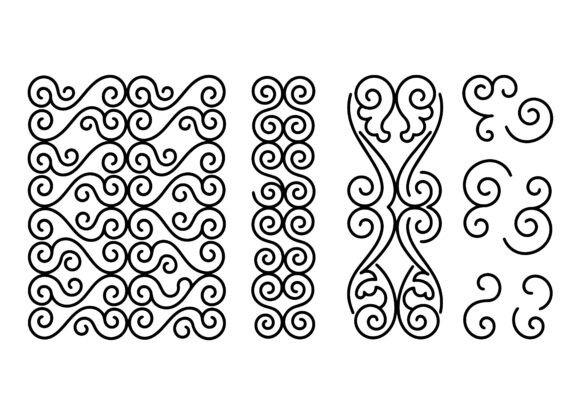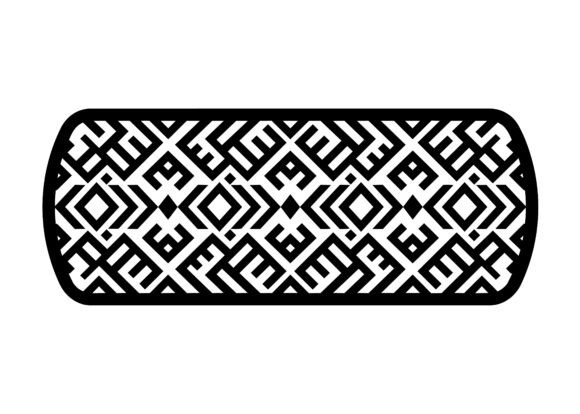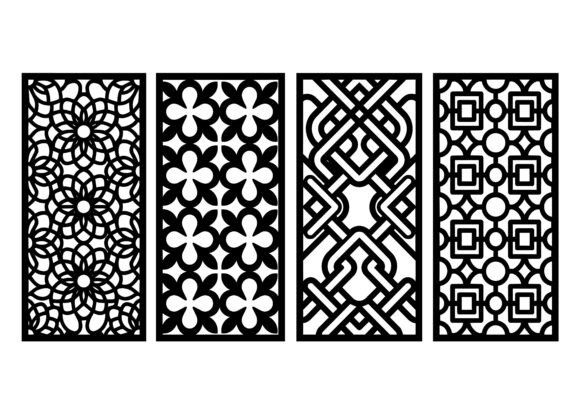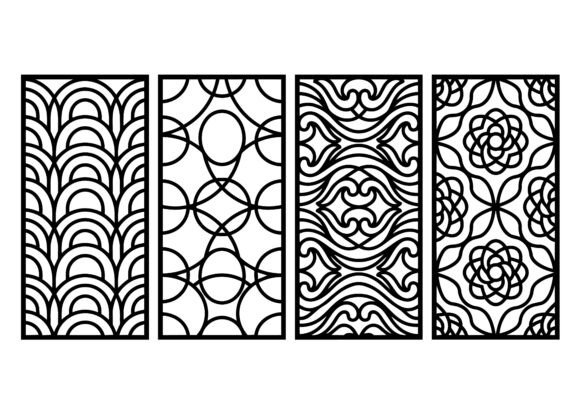
Abstract Geometric Pattern EPS Bundle: Precision Vector Design for Multi-Material Craft and Commercial Production
Designers, makers, and production professionals increasingly rely on vector-based assets that bridge digital ideation and physical execution. The Abstract Geometric Pattern EPS Bundle represents a focused evolution in this space—not merely a collection of decorative motifs, but a rigorously engineered set of scalable, production-ready patterns built for functional versatility. Unlike raster-based or loosely constructed vector files, this bundle emphasizes technical fidelity: clean Bézier paths, mathematically consistent repetition, and topology optimized for both visual harmony and machine readability. Its value lies not in aesthetic novelty alone, but in how its structural integrity translates across contexts—from laser-cut wooden wall panels to embossed packaging, from CNC-engraved acrylic signage to digitally printed textile repeats.
Core Structural Characteristics That Enable Real-World Use
At the foundation of the Abstract Geometric Pattern EPS Bundle is deliberate geometric logic. Each pattern is constructed using parametric principles—repeating curves follow precise radius continuity, circular compositions maintain radial symmetry without distortion at any scale, and wave structures adhere to harmonic frequency ratios. This isn’t stylistic preference; it’s engineering discipline. For example, a seamless wave motif within the bundle may use cubic Bézier curves with identical control point offsets across all segments, ensuring zero visible seams when tiled—even at 300% zoom in Adobe Illustrator or when rendered at 1:1 scale on a 4’×8’ CNC bed.
Floral-inspired geometry in the bundle avoids organic randomness. Petal-like forms are derived from intersecting arcs and rotated polygons, resulting in balanced negative space and predictable edge behavior during cutting. These aren’t illustrations of flowers—they’re abstractions rooted in symmetry groups (p3m1, p4g, p6m), making them inherently repeatable and mathematically stable. Such precision matters when a designer exports to DXF for plasma cutting or prepares a file for rotary engraving on brass: inconsistent anchor points or stray anchor handles can cause toolpath errors, material waste, or misaligned repeats.
All patterns are built in CMYK or grayscale mode with no embedded raster effects, transparency layers, or unexpanded strokes—common pitfalls that break compatibility with industrial RIP software or vector-to-G-code converters. Every element is fully editable, yet locked to its intended proportion and alignment. This dual nature—open for customization, stable for output—makes the Abstract Geometric Pattern EPS Bundle equally useful to a university design instructor demonstrating tessellation theory and a small-batch manufacturer preparing files for contract laser cutting.
Material-Agnostic Application Across Physical and Digital Domains
The bundle’s adaptability stems from its separation of form and substrate. Because EPS is a resolution-independent format defined by mathematical paths—not pixels—the same file performs identically whether scaled to 2 mm for micro-engraving on watch dials or stretched across a 3-meter architectural wall mural. This scalability enables direct application across diverse materials:
- Wood and Acrylic: Clean vector outlines translate directly to laser cutter paths. Curved segments cut smoothly without jagged interpolation; tight circular compositions maintain fidelity even at small diameters (e.g., 8 mm cutouts in 3 mm birch plywood). Users report up to 25% faster setup time compared to redrawing patterns from scratch, as registration marks, kerf compensation zones, and nesting guides can be added non-destructively to the original EPS layers.
- Fabric and Textiles: Seamless tiling allows for continuous print repeats on roll-fed digital textile printers. The absence of raster elements prevents moiré artifacts during halftone screening, while consistent line weights (0.01–0.25 pt) ensure clarity in both woven jacquard drafts and sublimation transfers. One textile studio used a wave-structured pattern from the bundle to develop a limited-run performance-wear line, where the rhythm of the repeat aligned with ergonomic seam lines—demonstrating how geometry can inform function, not just appearance.
- Metal and Paper: For foil stamping or die-cutting, crisp vector edges prevent ink bleed or paper fiber tear. A packaging designer applied a floral-inspired geometry variant to corrugated mailer templates, adjusting stroke weight to match the 0.3 mm minimum rule for steel-rule dies—without altering the underlying shape’s proportions. Similarly, metalworkers etching stainless steel panels used the same EPS file, converting strokes to centerline paths for uniform depth control.
Workflow Integration Beyond Aesthetic Decoration
Professionals don’t treat the Abstract Geometric Pattern EPS Bundle as static decoration—they embed it into iterative workflows. In architectural visualization, designers extract individual motifs as SVG symbols, then script parametric variations (e.g., scaling amplitude along a façade curve) using JavaScript in Figma or Python in Rhino. Educators use the bundle’s circular compositions to teach rotational symmetry in middle-school math labs, importing EPS files into GeoGebra to measure angles, calculate periodicity, and animate transformations.
For digital product teams, these patterns serve as system-ready UI elements. A fintech startup integrated a simplified wave structure as a subtle animated background in their dashboard—exported as an SVG with optimized path data, reducing load time by 40% versus PNG alternatives. Researchers studying visual cognition used the bundle’s controlled variables (e.g., identical curvature radii across different densities) to isolate perceptual thresholds in pattern recognition studies—highlighting how rigorously constructed geometry supports empirical inquiry.
Crucially, the bundle avoids over-engineering for niche tools. It delivers native EPS (v10), compatible with legacy systems like CorelDRAW X7 and modern pipelines via PDF/EPS import in Affinity Designer or Inkscape. No proprietary plugins, no cloud dependencies—just portable, deterministic vector data. This reliability matters when a craftsperson in a rural workshop shares files with a commercial printer in another time zone, or when open-source CNC firmware reads the same EPS-derived G-code without interpretation variance.
Practical Considerations for Professional Implementation
While the Abstract Geometric Pattern EPS Bundle removes many technical barriers, successful deployment depends on context-aware adaptation. First, verify color mode alignment: CMYK files intended for offset printing require different trapping rules than RGB digital displays. Second, consider stroke-to-fill conversion for laser cutting—if a design uses 0.01 pt strokes, they must be outlined before sending to most laser controllers, as thin strokes may be ignored or misinterpreted as hairlines.
Seamless tiling demands attention to tile boundaries. Though all patterns are constructed for true repetition, users should always test a 2×2 tile grid at actual output size to confirm no unintended gaps or overlaps—especially when applying gradients or blending modes post-import. For CNC applications, check layer naming conventions: some bundles group cut paths, engrave zones, and registration marks on separate layers labeled “CUT,” “ENG,” and “REG.” Consistent labeling reduces operator error in production environments.
Commercial licensing is explicitly granted for unlimited end-use, including resale of physical products (e.g., selling laser-cut coasters featuring a bundled pattern), but prohibits redistribution of the EPS files themselves or creation of competing pattern libraries. This balance supports ethical reuse while protecting the intellectual labor invested in constructing mathematically coherent, production-hardened geometry.
Why This Bundle Fits Evolving Creative and Industrial Needs
Contemporary design practice increasingly blurs the line between digital authoring and physical making. The rise of desktop CNC machines, accessible laser cutters, and affordable large-format digital printers has shifted demand toward assets that are *machine-literate*—not just visually compelling. The Abstract Geometric Pattern EPS Bundle responds to that shift by prioritizing vector hygiene over decorative flourish. Its repeating curves aren’t arbitrary flourishes; they’re calibrated for toolpath efficiency. Its circular compositions aren’t stylized ornaments; they’re built to rotate without accumulating rounding errors across dozens of iterations. Its floral-inspired geometry doesn’t mimic botany—it encodes structural logic applicable to acoustic panel layouts or heat-dissipation grilles.
This focus on cross-domain utility explains its adoption across sectors: interior designers specifying wall cladding for hospitality projects, educators developing STEAM curricula, indie game studios generating procedural UI textures, and industrial designers prototyping ergonomic surface grips. What unites these users is a need for geometry that behaves predictably—whether under a laser beam, a router bit, a loom shuttle, or a CSS transform. The Abstract Geometric Pattern EPS Bundle delivers that reliability not as a marketing claim, but as a measurable property embedded in every anchor point, curve segment, and tile boundary.