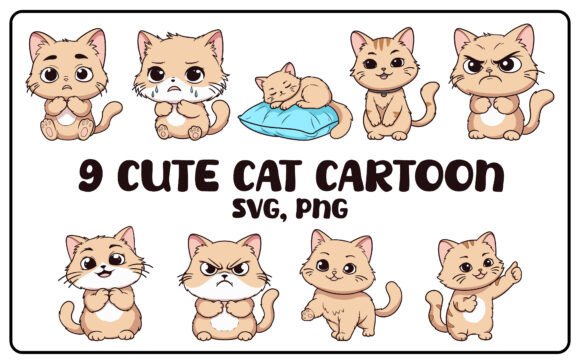
9 Cute Cat Cartoon
Whether you're designing a children’s newsletter, launching a pet-themed Shopify store, or spicing up an Instagram carousel for your small business, the right visual asset can shift tone, build warmth, and deepen connection—fast. That’s where 9 Cute Cat Cartoon stands out: not as generic clipart, but as a thoughtfully crafted, production-ready line art collection designed for real-world flexibility.
These aren’t just nine random cat illustrations. Each one carries distinct personality—curious, sleepy, playful, mischievous—while maintaining consistent linework, proportion, and stylistic cohesion. They’re drawn with clean vector precision, optimized for clarity at any scale, and delivered in both SVG and transparent PNG formats. That means no jagged edges on retina displays, no awkward white boxes when layered over gradients or photos, and no wrestling with background removal tools.
Why These Cats Work Where Others Don’t
Most cartoon cat assets fall into two camps: overly complex raster files that pixelate when enlarged, or minimalist vectors so stripped-down they lack charm. 9 Cute Cat Cartoon bridges that gap. The line weight is intentional—not too thin to vanish on mobile, not so thick it feels heavy or juvenile. Curves are smooth but expressive. Eyes are simple yet emotive. And because every element is fully editable in Illustrator, Figma, or even modern web editors like Penpot, you’re never locked into someone else’s color choices or composition.
You can recolor whiskers separately from ears. Swap paws without redrawing limbs. Adjust tail curl radius with a single node. That level of control matters when you’re matching brand palettes, adapting for accessibility (e.g., high-contrast versions), or building animated sequences frame-by-frame.
Real Use Cases Across Roles
Educators use these cats to soften learning materials—labeling parts of speech with a “grammar cat” holding a speech bubble, or illustrating cause-and-effect in science worksheets with a curious feline observing a rolling ball. Because the PNGs have transparent backgrounds, they drop cleanly onto PDF handouts or Google Slides without cropping or shadow artifacts.
Freelance designers embed the SVGs directly into client websites using inline code—no HTTP requests, no loading delays, and full CSS control over stroke color, animation timing, or hover effects. One designer recently used three of the cats as interactive navigation icons for a veterinary clinic’s site, changing their colors on hover to match the practice’s teal-and-cream palette.
Bloggers and content creators layer them over custom quote graphics or podcast episode thumbnails. A productivity coach added the “focused cat” (paw on notebook, tail curled neatly) to her Canva templates—replacing stock photos with something more ownable and on-brand. No licensing surprises, no attribution required.
Small business owners print them on packaging inserts, thank-you cards, or even embroidery patches for staff uniforms. Because the SVGs scale infinitely, the same file works for a 2-inch label sticker and a 48-inch trade show banner—without reworking or resampling.
What Makes the Transparency So Practical?
It’s not just about convenience—it’s about creative fidelity. When you place a transparent PNG over a textured background, gradient, or photo, the underlying layer shows through *naturally*. There’s no artificial halo, no mismatched edge blur, no need to manually feather masks in Photoshop. You get clean integration in under ten seconds, whether you’re using Affinity Photo, GIMP, or even PowerPoint.
This also simplifies A/B testing. Need to compare how a landing page performs with warm vs. cool-toned cats? Swap colors in five minutes—not hours—by editing the SVG fill values or applying CSS filters. No round-trip to a designer. No waiting on revised assets.
Smart Implementation Tips
Start by identifying your primary use case before diving into edits. If you’ll be printing, confirm your printer supports CMYK-converted SVGs—or export PNGs at 300 DPI. For web use, compress the SVG with SVGO (free online tools work fine) to keep file size under 15 KB without visible loss.
Don’t assume all nine cats suit every context. The “cat peeking from behind a book” reads well for education or publishing—but might feel off-brand for a fintech SaaS dashboard. Choose based on narrative alignment, not just cuteness.
If you’re building a design system, treat these as modular components. Name layers logically in your vector editor (“ear-left”, “tail-loop”, “paw-front”) so future collaborators (or your future self) can navigate edits efficiently. Save color variations as named swatches—not just hex codes—to maintain consistency across projects.
What to Watch For
Not all “transparent PNG” assets deliver equal quality. Some include faint anti-aliasing halos or semi-transparent edge pixels that muddy overlays. With 9 Cute Cat Cartoon, transparency is crisp and binary—true alpha channel, no fringing. Still, always preview on your intended background color or image before finalizing layouts.
Also consider scalability limits of your output medium. While SVGs scale infinitely in theory, very fine lines may disappear on low-res screens or tiny print sizes. Test at your smallest expected display size—especially if using the cats in app UI icons or email footers.
Finally, remember that simplicity serves function. These cats succeed because they avoid visual noise—no busy patterns, no competing textures, no distracting shadows. That restraint makes them adaptable across contexts where clarity and speed matter most.
Whether you're sketching wireframes, drafting lesson plans, or prepping a product launch, 9 Cute Cat Cartoon isn’t just decoration. It’s a lightweight, reliable tool that saves time, strengthens voice, and invites engagement—without demanding technical overhead or creative compromise.