Trees with and Without Leaves: A Visual Resource for Design, Storytelling, and Strategic Communication
Visual assets like Trees with and Without Leaves aren’t just decorative—they’re functional tools that support clarity, contrast, and narrative intention in real-world projects. Whether you’re designing a seasonal brand campaign, illustrating a climate education module, or building a cinematic storyboard, the ability to juxtapose leafy and bare tree silhouettes gives you immediate visual language for change, transition, growth, or loss. This isn’t about stock imagery; it’s about having a precise, production-ready asset—available as both EPS and JPG—that integrates cleanly into professional workflows without compromising scalability or consistency.
What You’re Actually Getting—and Why Format Matters
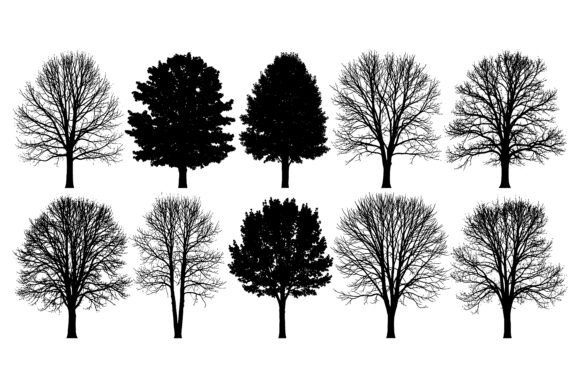
The Trees with and Without Leaves collection delivers two complementary visual states in one cohesive package: full-canopy deciduous trees and their stark, branch-dominant counterparts. Both are rendered as clean black silhouettes on white background—no gradients, no texture noise, no embedded effects. That intentional minimalism serves a practical purpose: it ensures compatibility across platforms (Adobe Creative Cloud, Figma, Canva, PowerPoint), print specifications (CMYK conversion, bleed-safe sizing), and responsive layouts (SVG export from EPS, crisp scaling at any resolution).
The dual-file format—EPS for vector precision and JPG for quick placement—means you don’t have to choose between editability and speed. Need to isolate a single branch for an animated motion graphic? Open the EPS in Illustrator, ungroup, and extract. Preparing a blog header that loads fast on mobile? Drop in the optimized JPG. This isn’t redundancy—it’s workflow redundancy avoidance.
Where It Fits in Your Process (Before, During, and After)
Before a project starts: Use the silhouettes to define visual tone early. For educators mapping a unit on plant biology, pairing leafy and bare trees helps scaffold concepts like dormancy, photosynthesis cycles, or ecosystem adaptation—before writing a single slide. Marketers building a Q4 sustainability report can use the contrast to visualize “before/after” environmental impact metrics, grounding abstract data in instantly legible form.
During execution: The files act as modular components—not static images. In UI design, layer a bare tree silhouette behind transparent text to imply structure without distraction. In video editing, animate the transition between leafy and bare versions (using alpha channels from the EPS) to signal seasonal time jumps—a subtle but effective cinematic cue. Freelancers pitching rebranding work can embed both versions side-by-side in a mood board to show clients how visual metaphors evolve across campaign phases.
After delivery: These assets hold long-term utility because they’re style-agnostic. Unlike trend-dependent illustrations, black silhouettes adapt across color systems, typography choices, and layout densities. A publisher using them in a 2023 textbook can reuse the same files in a 2026 revision—no redesign needed. That consistency reduces version control overhead and preserves visual continuity across iterations.
Integration With Other Tools and Assets
You don’t use Trees with and Without Leaves in isolation—it works best when paired intentionally. In Figma, place the JPG as a locked background layer while building interactive prototypes; its neutrality keeps focus on user flow, not decoration. In Adobe After Effects, import the EPS as a composition, then apply displacement maps or light leaks to create organic movement—branches subtly swaying, leaves appearing frame-by-frame—without needing custom illustration.
For educators and trainers, combine the silhouettes with editable text boxes in Google Slides or Notion to build interactive timelines: drag the bare version to “Winter,” the leafy one to “Summer,” and annotate with local phenology data. Small business owners running seasonal promotions can drop both into Mailchimp templates—using the bare tree for “Prep Season” emails and the leafy version for “Launch Week”—creating subconscious visual rhythm across touchpoints.
Practical Implementation Tips for Real Workflows
- Organize by function, not file type: Create folders named “Transition Visuals” or “Seasonal Contrast” instead of “EPS” and “JPG.” That aligns with how you’ll search for them mid-project—not by extension, but by intent.
- Pre-size for common uses: Save derivative JPGs at 1200px width (for web banners), 2480px height (for print posters), and 720p (for video lower thirds). Name them clearly: trees-bare-1200w.jpg, trees-leafy-720p.jpg. Saves seconds per project—minutes per week.
- Test contrast early: Drop both silhouettes onto your brand’s primary background colors before finalizing layouts. Black-on-white is safe—but if your site uses dark mode or off-white backgrounds, verify legibility. Adjust stroke weight (in the EPS) if needed—don’t rely on shadow or glow effects to compensate.
- Use branches as dividers—not just trees: Ungroup the EPS and repurpose individual limbs as section breaks in reports or as connecting lines in infographics. Their organic shape adds visual interest without competing with content.
Quality Control and Long-Term Usability
Because these are vector-based silhouettes, quality control is built in—but only if used correctly. Avoid rasterizing the EPS unless necessary. If you must convert to PNG, export at 300 DPI and retain transparency. Never stretch the JPG disproportionately; that introduces pixelation and undermines the clean aesthetic the files are designed to deliver.
Long-term, the value compounds through reuse discipline. Track where each version appears—e.g., “bare tree used in Q3 sustainability dashboard,” “leafy version in spring product launch email.” That log informs future decisions: if stakeholders respond strongly to the contrast in one context, replicate the pattern elsewhere. It also surfaces inconsistencies—if the bare tree appears in a “growth” metaphor somewhere, revisit the messaging alignment.
Why This Works Across Roles and Goals
A freelance illustrator uses the silhouettes as underlays to trace custom foliage styles—saving hours on branch structure while focusing creative energy on texture and lighting. A nonprofit communications manager layers them into advocacy social posts to visualize deforestation timelines without licensing complex photography. A curriculum developer embeds them into interactive PDFs, assigning click-triggered audio explanations (“Why do some trees lose leaves?”) to each silhouette—turning passive visuals into active learning moments.
What ties these uses together isn’t aesthetics alone—it’s intentionality. Trees with and Without Leaves gives you a reliable, scalable way to represent duality: presence and absence, activity and rest, complexity and simplicity. That makes it useful not just for designers, but for anyone who needs to communicate change, contrast, or cycle—not as abstraction, but as something immediately visible, editable, and deployable.
Final Note on Integration
Don’t wait for the “perfect” project to use this. Add the files to your default template library. Test them in one low-stakes context first—a team meeting slide, a personal journal cover, a draft social post. Notice how quickly the contrast clarifies your point. Then scale outward. The goal isn’t to use every silhouette in every project—it’s to have the right visual tool ready when meaning depends on it.