People Walking Holding Hands Family
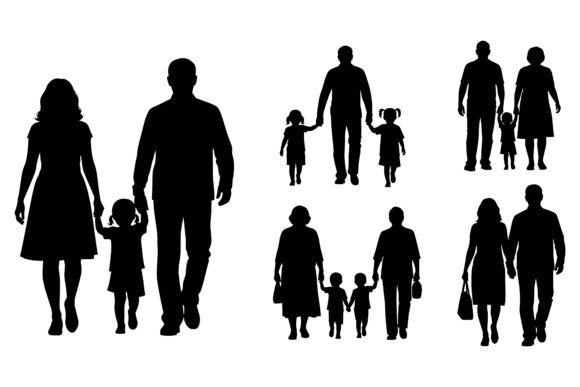
Black silhouettes of people walking holding hands—adults and children, side by side, in relaxed motion against a clean white background—are more than just simple vector art. They’re a visual shorthand for connection, unity, and quiet intention. The People Walking Holding Hands Family collection—available as both an EPS file for scalable editing and a high-resolution JPG for immediate use—offers designers, educators, marketers, and content creators a versatile, timeless asset grounded in human-centered storytelling.
Why This Silhouette Style Works So Well
Unlike photorealistic imagery, these black-on-white silhouettes remove distractions: no facial expressions to interpret, no clothing trends to date, no lighting or color choices to clash with your layout. What remains is pure gesture—hands held, bodies aligned, movement implied—and that’s where their strength lies. The simplicity invites interpretation while maintaining emotional resonance. A viewer doesn’t need context to understand care, support, or shared direction.
This makes the People Walking Holding Hands Family set especially effective for inclusive communication. Because it avoids specific ethnic features, gendered styling, or age markers beyond general proportion, it can represent diverse family structures—multigenerational households, blended families, caregiver-child pairs, or even symbolic representations of teamwork—without over-explaining or excluding.
Creative Applications Across Real Projects
Designers often reach for this kind of silhouette when building visual systems that prioritize clarity and warmth. Here’s how different users apply it meaningfully:
- Small business owners use it on welcome banners, community program flyers, or “About Us” web sections to reinforce values like trust and collaboration—without resorting to stock clichés.
- Educators and nonprofit communicators integrate it into handouts about social-emotional learning, family engagement initiatives, or mental health resources—where tone matters as much as information.
- Bloggers and content creators layer it subtly behind text blocks or use cropped versions as section dividers, adding rhythm and cohesion to long-form posts about parenting, relationships, or personal growth.
- Freelance illustrators and UI designers treat the EPS file as a base layer—recoloring elements, combining figures into custom groupings, or animating gentle forward motion for micro-interactions in apps or presentations.
One practical example: A local library launched a summer reading challenge themed “Walk Together, Read Together.” They used three variations from the People Walking Holding Hands Family set—one with two adults and one child, another with two children and an adult, and a third with four figures—to illustrate different participation options across posters, email headers, and social media carousels. Consistency in style made the campaign feel unified; flexibility in composition kept it relatable.
How to Use It Without Losing Impact
Even strong visuals can fade into background noise if overused or poorly placed. To keep results clear and audience-friendly:
- Respect negative space. These silhouettes thrive against clean backgrounds—not busy textures or competing patterns. If placing them over photography or gradients, use a subtle white stroke or soft drop shadow to ensure legibility.
- Scale intentionally. The EPS format allows resizing without loss, but avoid stretching figures unnaturally. Maintain proportional harmony—e.g., don’t enlarge a single child figure to match the height of a full family group unless part of a deliberate visual hierarchy.
- Pair with purposeful typography. Use sans-serif fonts with open letterforms (like Inter, Lato, or Montserrat) to complement the clean lines of the silhouettes. Avoid overly decorative or condensed typefaces that compete for attention.
- Vary grouping—not just quantity. Instead of always using the largest family configuration, try pairing two individuals walking side-by-side for themes of mentorship or friendship, or isolate a parent-and-child pair for early childhood materials.
Adapting for Different Platforms and Goals
The same core image serves very different functions depending on context. A marketer building a landing page might use the full family group at hero-section scale to anchor an emotional hook—“Your journey starts here”—while linking to a lead form. In contrast, an educator preparing a classroom slide deck may extract just two figures walking together and animate them moving left-to-right across the screen to visualize progression or growth.
For digital publishing, the JPG version works reliably across CMS platforms and email clients where SVG or EPS aren’t supported. For print materials—brochures, workshop handouts, signage—the EPS ensures razor-sharp edges at any size. And because the files are delivered without embedded fonts or linked assets, there’s no risk of broken elements during handoff between team members or vendors.
Keeping It Original and Audience-Appropriate
Originality doesn’t require reinventing the silhouette—it comes from thoughtful adaptation. Try flipping a pair horizontally to change directional emphasis, or overlaying a faint path line beneath feet to suggest forward momentum. Add a single accent color to one hand or shoe to highlight connection or draw attention to a key message point.
When tailoring for specific audiences, consider what “family” means in their context. For a senior wellness program, emphasize intergenerational pairs. For a startup’s internal culture deck, use adult-only configurations to signal peer support or leadership alignment. Always ask: *Does this reflect who we’re speaking to—not just who we assume they are?*
Finally, remember that consistency builds recognition—but repetition without variation breeds invisibility. Rotate through different compositions across touchpoints. Let one platform feature a wide group walking together; let another spotlight a quiet, single-file line. That subtle shift signals intentionality, not randomness.
The People Walking Holding Hands Family collection isn’t about depicting perfection. It’s about offering a flexible, respectful, and human-scale visual language—one that supports real work, real messages, and real connection—without demanding attention for its own sake.