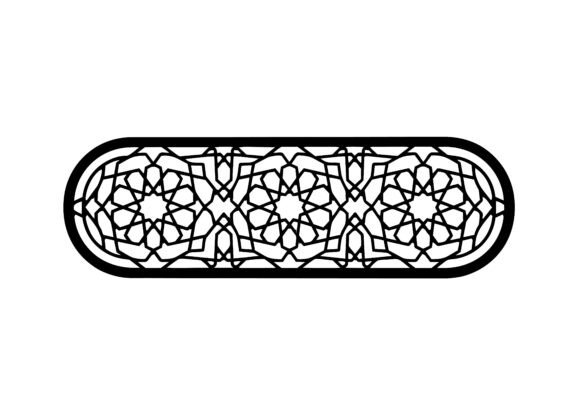
Islamic Geometric Pattern Bookmark EPS
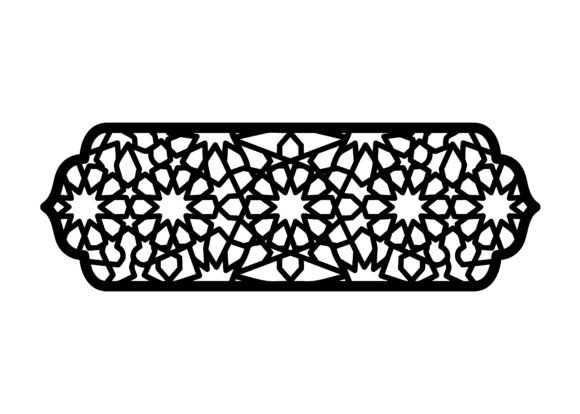
An Islamic Geometric Pattern Bookmark EPS is more than a decorative file—it’s a precision-crafted vector asset designed for real-world fabrication and thoughtful integration into creative, educational, and commercial workflows. Built from centuries-old principles of symmetry, proportion, and repetition, this bookmark combines traditional star motifs and arabesque-inspired geometry in a seamless horizontal layout—optimized for both visual harmony and technical performance. Its rounded silhouette isn’t just aesthetic; it’s engineered for physical durability and ergonomic handling when cut or engraved.
Unlike raster images or generic clipart, the EPS format delivers mathematically defined paths—clean, scalable, and resolution-independent. That means whether you’re laser-cutting a batch of bookmarks from 3mm walnut or CNC-engraving fine detail onto brass sheeting, every line remains razor-sharp at any size. No pixelation. No re-tracing. No guesswork. This level of fidelity makes the Islamic Geometric Pattern Bookmark EPS especially valuable for makers who prioritize consistency across iterations—whether producing five prototypes or five hundred retail units.
Where It Fits in Your Workflow
This asset doesn’t exist in isolation. It integrates at multiple points in a project lifecycle—before design begins, during production planning, and even after delivery as part of brand or cultural storytelling.
Before production starts, the Islamic Geometric Pattern Bookmark EPS serves as a ready-to-deploy foundation. Designers skip the time-intensive process of constructing complex tessellations from scratch. Instead, they import the file directly into Adobe Illustrator, CorelDRAW, or Inkscape, then adjust stroke weight, color fills, or spacing to match material thickness or engraving depth requirements. Educators preparing classroom kits can scale the pattern to fit standard A5 notepads or adjust curvature radius for child-sized hands—without compromising structural integrity.
During fabrication, its vector-native structure streamlines machine setup. Laser cutters read closed paths with consistent directionality, minimizing unnecessary travel time. CNC software interprets the clean anchor points and smooth Bezier curves without error-prone auto-tracing. For leatherworkers using rotary tools, the precise edge definition ensures crisp impressions—even on textured surfaces. The file’s lack of embedded raster elements or transparency layers eliminates compatibility hiccups across platforms like LightBurn, RDWorks, or Fusion 360.
After completion, the bookmark becomes a functional artifact that communicates intention. When used in Islamic studies courses, museum gift shops, or interfaith outreach programs, it bridges aesthetics and meaning—offering tactile engagement with geometric discipline as a form of contemplative practice. Its presence reinforces values of balance, order, and reverence for craft—qualities that resonate deeply with audiences seeking authenticity over ornamentation.
Material Compatibility and Practical Adjustments
The Islamic Geometric Pattern Bookmark EPS performs reliably across diverse substrates—but optimal results depend on intentional calibration:
- Wood: Use kerf compensation (typically 0.1–0.2mm) to account for sawdust loss. Reduce power slightly for hardwoods like cherry or maple to avoid charring along fine lines.
- Acrylic: Prioritize high-polish settings—especially for clear or translucent sheets—to maintain clarity through intricate intersections. Avoid excessive speed that causes micro-fractures near sharp star points.
- Leather: Convert strokes to outlines before embossing or debossing. Test pressure on scrap pieces: too little yields faint impressions; too much distorts the delicate arabesque flow.
- Metal: For etching or thin-gauge engraving, ensure all strokes are ≥0.08mm thick to prevent breakage. Consider adding subtle bevels in post-processing software if depth control is limited.
These aren’t theoretical suggestions—they reflect tested adjustments made by small-batch producers who’ve shipped thousands of units across Etsy, local book fairs, and university co-ops. Consistency comes from treating the EPS not as static art, but as an adaptable component within a broader system of tools, materials, and expectations.
Integration With Other Assets and Platforms
You’ll rarely use the Islamic Geometric Pattern Bookmark EPS alone. It gains strength when paired intentionally:
- With complementary Arabic calligraphy vectors, it forms cohesive sets—e.g., pairing a star-patterned bookmark with “Ilm” (knowledge) script for academic gifts.
- In branding packages, it anchors stationery systems: matching business cards, letterheads, and digital templates share the same underlying geometry, reinforcing visual continuity without repeating identical motifs.
- Alongside educational PDFs or printable worksheets, it supports learning objectives—students analyze symmetry axes, count rotational orders, or map frequency of eight-pointed stars versus hexagons.
- Within e-commerce product pages, high-res mockups generated from the EPS file show realistic wood grain or metal sheen—building trust before purchase.
This interoperability matters because your time is finite. Choosing a well-structured, commercially licensed EPS means avoiding licensing disputes, redrawing loops, or last-minute vendor revisions. It also means less friction when collaborating—designers hand off to fabricators with confidence; educators share files with curriculum teams knowing permissions are clear.
Long-Term Usability and Quality Control
A key advantage of this Islamic Geometric Pattern Bookmark EPS lies in its longevity—not just shelf life, but adaptability across evolving needs. Because it’s built with industry-standard vector conventions (no hidden layers, no linked fonts, no embedded effects), it opens cleanly in software versions spanning a decade. You won’t hit version lock-in or require costly conversion services.
For quality control, establish simple checkpoints before each run:
- Verify all paths are closed and non-overlapping.
- Confirm stroke alignment is centered (not inside or outside).
- Check bounding box dimensions against your target physical size—especially if scaling for different materials.
- Run a test cut/engrave on scrap material using actual machine settings—not just preview mode.
These steps take under two minutes but prevent hours of rework. They also build muscle memory: over time, you develop instinctive fluency with how geometry translates across mediums. That fluency compounds—each successful project refines your judgment about spacing, contrast, and negative space, making future adaptations faster and more intuitive.
Finally, consider archiving. Store the original EPS alongside dated notes: “Used for Ramadan literacy campaign, 2024 — scaled to 180mm × 32mm, cut from 2mm birch plywood.” That kind of documentation transforms a single file into a living resource—one that grows richer with every application, not just in output, but in understanding.