Orchids Flowers Illustrations: A Practical Guide for Designers and Crafters
Orchids Flowers Illustrations refer to a curated collection of digital floral artwork—specifically stylized, hand-drawn or digitally rendered orchid motifs—designed for flexible creative reuse. Unlike stock photo libraries or generic clipart, these illustrations are created with intention: clean lines, balanced negative space, and botanical accuracy that supports both aesthetic appeal and functional adaptability. They’re not photographs of real orchids, nor are they AI-generated composites; they’re original digital designs crafted for clarity, scalability, and visual cohesion across projects.
What Sets These Orchids Flowers Illustrations Apart
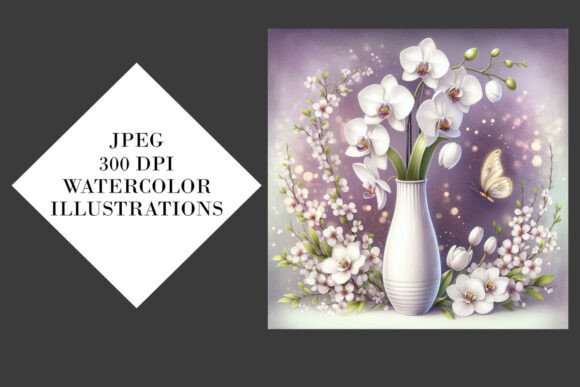
The distinguishing feature lies in their purpose-built specifications and licensing model. Each illustration is delivered as a high-resolution JPEG file—2400x2400 pixels, 8x8 inches at 300 DPI—ensuring crisp printing on physical goods like greeting cards or scrapbook paper. That resolution bridges the gap between screen use and professional print output without requiring vector conversion or upscaling compromises.
Equally important is the commercial-use license. You’re permitted to incorporate these Orchids Flowers Illustrations into finished products you sell: custom stationery, digital planners, printable wall art, fabric patterns, or even small-batch craft kits. The license doesn’t require attribution, nor does it limit quantity or platform—you can use them on Etsy, your own website, or in client work, provided the final product reflects meaningful transformation.
How They Compare to Other Floral Design Resources
Many designers begin their search with free SVG files, subscription-based design platforms, or royalty-free stock sites. Each option carries tradeoffs:
- Free SVG or PNG downloads often lack consistent style, contain embedded watermarks, or come with restrictive licenses—especially regarding resale. Some prohibit commercial use entirely, while others require attribution on every item sold, which isn’t always practical for mass-produced goods.
- Subscription services offer volume and variety but lock users into recurring fees and may restrict offline use or limit download counts. You also don’t retain perpetual rights—if the service shuts down or changes terms, access ends.
- Photographic orchid assets excel in realism but fall short when you need flat, scalable, editable elements. Shadows, lighting variations, and background clutter make them harder to integrate cleanly into minimalist layouts or layered digital planners.
In contrast, Orchids Flowers Illustrations provide a middle path: one-time acquisition, no ongoing cost, full commercial rights, and format consistency. They’re optimized for immediate integration—not discovery, curation, or technical troubleshooting.
Strengths and Real-World Use Cases
Their strength emerges most clearly in projects where visual harmony and production efficiency matter. For example:
- A small business owner creating a line of botanical-themed thank you cards can layer an Orchids Flowers Illustration over textured paper backgrounds, adjust color tone to match brand palettes, and export ready-to-print PDFs—all without licensing uncertainty.
- A digital planner designer might place a delicate orchid motif in the corner of a weekly spread, resize it without pixelation, and include it across dozens of pages knowing the resolution holds up on both iPad screens and printed inserts.
- A scrapbooking enthusiast can print multiple sizes onto cardstock, cut them out by hand, and combine them with pressed flowers or metallic foil accents—no need to worry about copyright notices on physical displays or craft fairs.
This flexibility stems from intentional design choices: centered composition, neutral backgrounds (often white or transparent-ready), and stylistic continuity across the set. You’re not getting isolated motifs—you’re getting a cohesive visual vocabulary.
Limitations and When to Look Elsewhere
These Orchids Flowers Illustrations aren’t suited for every need. If your project requires:
- Vector scalability (e.g., large-format signage or embroidery digitizing), JPEGs—even at 300 DPI—won’t substitute for native SVG or AI files. While 2400x2400 pixels works well for standard print sizes, enlarging beyond ~12x12 inches risks visible interpolation.
- Dynamic editing (e.g., changing individual petal colors non-destructively), raster formats limit flexibility compared to layered PSD or vector sources. Adjustments must be made in raster editors like Photoshop or Affinity Photo.
- Photorealistic depth or texture, such as subtle veining, dew drops, or macro-level detail, these illustrations prioritize elegance and clarity over hyperrealism. They’re decorative, not documentary.
Similarly, if your workflow depends on automated asset management—like syncing illustrations directly into Canva templates or Figma libraries—the lack of cloud-based organization means manual upload and version tracking falls to you.
Licensing Clarity: What’s Allowed, What’s Not
The commercial license grants broad usage freedom—but with clear boundaries designed to protect the creator’s work and maintain value for buyers. You may:
- Embed Orchids Flowers Illustrations into physical or digital products you sell (e.g., greeting cards, planners, stickers, T-shirt prints).
- Use them in client deliverables (e.g., branded social media graphics, presentation decks) where the illustration is part of a larger, original composition.
- Modify colors, scale, orientation, or combine with other assets to create new derivative works.
You may not:
- Resell, redistribute, or share the JPEG files in their original, unaltered form—whether as standalone downloads, freebie bundles, or on design-sharing platforms.
- Offer the raw files as part of a “resource pack” or template kit where the primary value is the inclusion of the illustrations themselves.
- Claim authorship of the original artwork or register copyright over the unmodified files.
This balance ensures sustainability: creators continue producing high-quality, niche-focused illustrations because their work retains distinct value, while users gain reliable, legally sound assets for their own ventures.
Making the Right Choice for Your Workflow
Orchids Flowers Illustrations are most valuable when you prioritize simplicity, legal confidence, and visual consistency over maximal format options or infinite variation. They suit makers who already have a defined aesthetic direction and want to accelerate execution—not those still exploring stylistic possibilities or needing extensive technical customization.
If you frequently switch between print and digital outputs, manage multiple product SKUs, or serve clients with strict branding guidelines, the predictability of these files saves time and reduces compliance risk. But if your work leans heavily into generative tools, rapid prototyping with AI-assisted iteration, or collaborative cloud-based design, you may find more utility in platforms offering real-time editing or API-driven access.
There’s no universal “best” floral resource—only what fits your current scope, skill level, and long-term goals. Orchids Flowers Illustrations meet a specific, well-defined need: dependable, licensable, print-ready botanical art that integrates smoothly into established creative pipelines. When that alignment exists, they become less of a purchase and more of a practical extension of your toolkit.