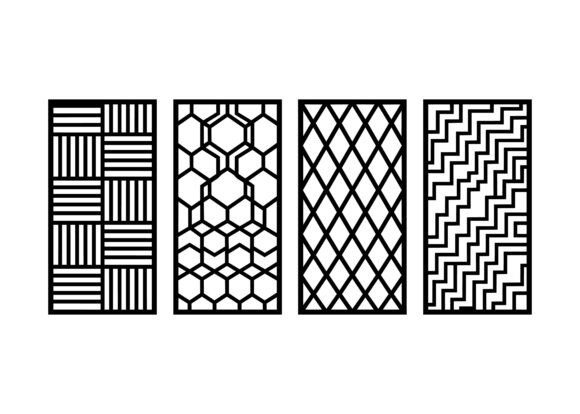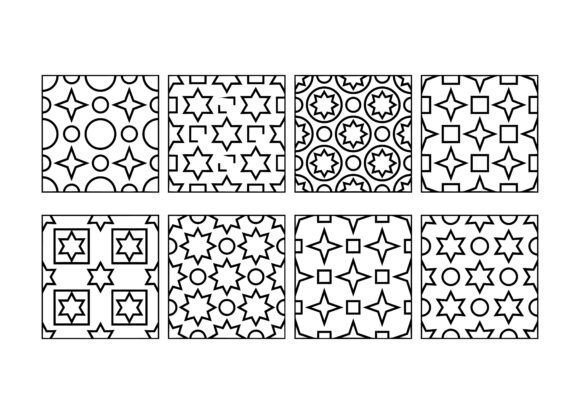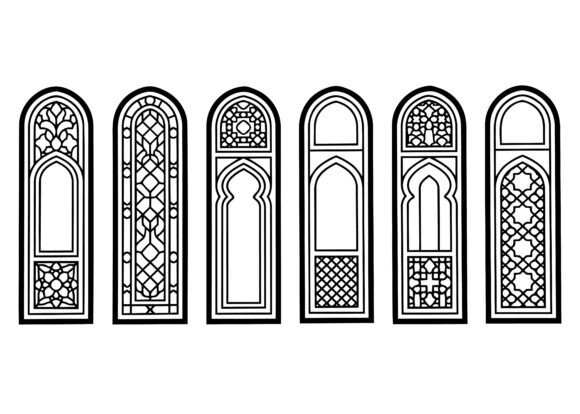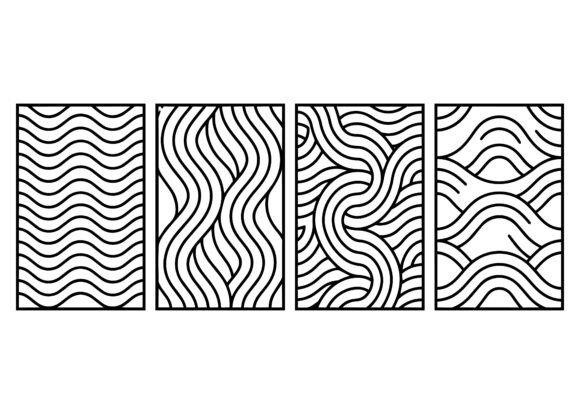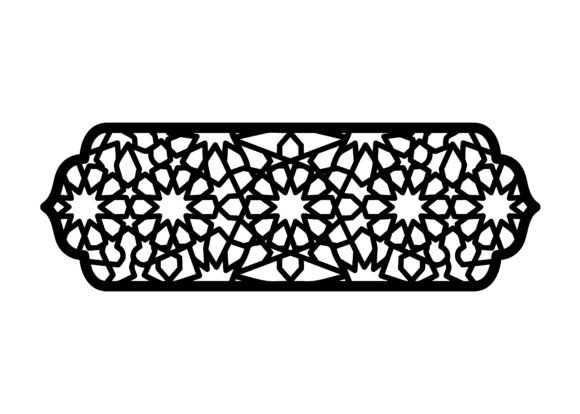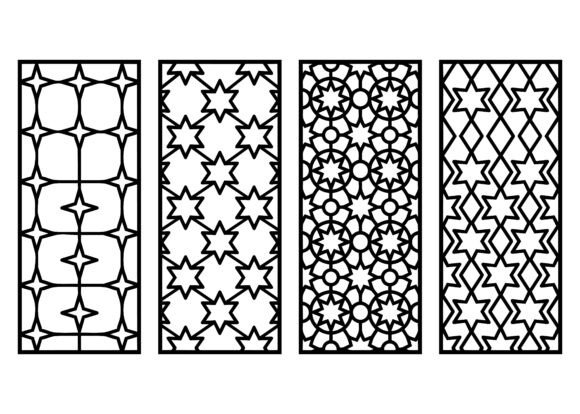
Islamic Star Pattern Panel EPS Bundle
Geometric precision meets cultural depth in the Islamic Star Pattern Panel EPS Bundle — a curated set of vector-based designs rooted in centuries-old Islamic and Moroccan ornamental traditions. Each pattern features interlocking stars, radial symmetry, and seamless repeating lattices, rendered with crisp, clean lines optimized for digital fabrication and surface application. Unlike raster images or low-resolution graphics, these EPS files retain flawless clarity at any scale — whether etched onto a 2-inch ceramic tile or laser-cut into a 10-foot architectural screen.
Why this matters — depending on who you are
What makes the Islamic Star Pattern Panel EPS Bundle valuable isn’t just its visual elegance — it’s how that elegance translates into real-world utility. That translation looks different for each person.
For designers and makers working with physical materials
If you cut, engrave, or print on wood, acrylic, metal, or fabric, vector fidelity is non-negotiable. These EPS files open directly in Adobe Illustrator, CorelDRAW, or Inkscape — no pixelation, no re-tracing, no guesswork. A furniture maker can import a 12-point star lattice into their CNC software and mill it into walnut paneling without adjusting anchor points. A textile designer can tile a circular composition across a repeat swatch for silk scarves — all while preserving line weight consistency and alignment integrity.
For educators and students of art, architecture, or cultural studies
This bundle offers more than decoration — it’s a teaching tool. The patterns reflect mathematical sophistication: tessellations based on Euclidean geometry, rotational symmetry, and modular repetition. An art history instructor might use one panel to demonstrate how 14th-century zellige tilework informed modern parametric design. A high school math teacher could project a star-and-polygon motif to explore angles, ratios, and group theory — making abstract concepts tactile and culturally grounded.
For small business owners and product creators
Time and licensing clarity matter. These files are delivered as ready-to-use EPS assets — no subscriptions, no watermarks, no attribution requirements. A boutique lighting company can embed a six-fold star motif into a pendant light’s brass diffuser, then produce 50 units without revisiting the file. A stationery brand launching Ramadan-themed gift boxes can adapt a circular composition into foil-stamped lid patterns — confident that the vector paths will hold during prepress and die-cutting.
For hobbyists and DIY enthusiasts
You don’t need a workshop or a design degree to benefit. Many users start by printing a pattern onto adhesive vinyl, then applying it to a cabinet door or wall panel for instant, elevated texture. Others import the EPS into free tools like Inkscape to recolor elements or isolate sections for papercraft or stenciling. Because the lines are clean and uncluttered, even beginners find it easier to modify spacing, adjust stroke width, or extract individual motifs for embroidery templates.
What “ready for commercial use” actually means
“Commercial use” isn’t a vague promise here — it’s built into the file structure and delivery. Each EPS is:
- Fully layered and named (e.g., “border,” “field,” “center medallion”) so you can hide, lock, or recolor components without breaking alignment;
- Constructed with compound paths and minimal anchor points — reducing processing lag in laser controllers and cutting software;
- Tested across common workflows: from LightBurn and RDWorks to Silhouette Studio and Cricut Design Space (via PDF export);
- Supplied with a clear license summary covering resale of end products — no ambiguity about selling laser-cut wall art or printed fabric yardage.
How quality shows up in practice
Not all geometric bundles deliver the same level of craftsmanship. In this collection, quality appears in subtle but critical ways:
- Consistent stroke weights: No accidental hairlines or thickened joins — essential when scaling down for jewelry or up for signage.
- True circular compositions: Radii align precisely; no wobble in rotational repeats — vital for centered applications like ceiling medallions or tabletop inlays.
- No embedded fonts or raster effects: Everything is pure vector. What you see in Illustrator is exactly what cuts or prints.
- Thoughtful tiling logic: Patterns repeat edge-to-edge without visible seams — no manual offsetting needed for wall panels or floor tiles.
A few real examples — no hypotheticals
A Cairo-based interior studio used a 16-point star panel to create perforated aluminum screens for a rooftop café — the clean vector lines translated directly into precise CNC drill paths, minimizing material waste. A Portland-based educator printed simplified versions of three motifs onto cardstock, then had students assemble them using magnets and dry-erase boards to explore symmetry operations. A Berlin-based packaging designer adapted a lattice structure into embossing dies for luxury olive oil bottles — the fine-line detail held up beautifully in foil stamping.
Does this fit your current needs?
Ask yourself:
- Are you working with physical substrates — especially where precision cutting or engraving is involved? Then yes — EPS vector format is the right foundation.
- Do you value cultural authenticity *and* technical reliability? Then yes — these aren’t stylized approximations, but research-informed interpretations built for accuracy.
- Is scalability a hard requirement — for instance, resizing a motif from a business card to a trade show backdrop? Then yes — EPS avoids resolution limits entirely.
- Are you evaluating alternatives that offer PNGs, JPEGs, or SVGs instead? Consider whether those formats support your workflow: PNGs blur when enlarged, SVGs sometimes misrender in laser software, and JPEGs can’t be edited meaningfully.
The Islamic Star Pattern Panel EPS Bundle doesn’t try to be everything — it excels where vector precision, cultural resonance, and fabrication readiness converge. It’s not meant for quick social media graphics or animated web banners. But if your work lives at the intersection of craft, culture, and clean geometry — whether you’re sketching a concept, running a router, teaching a class, or launching a product — it’s built to support that work, quietly and effectively.