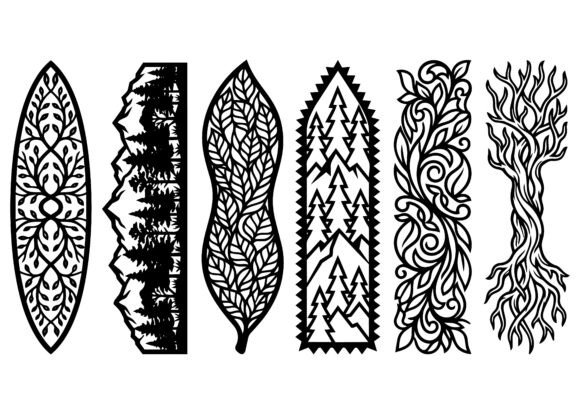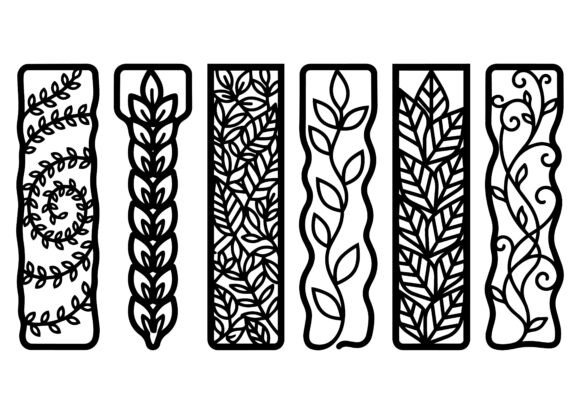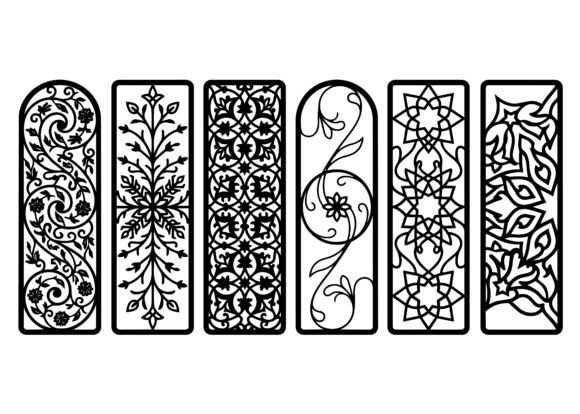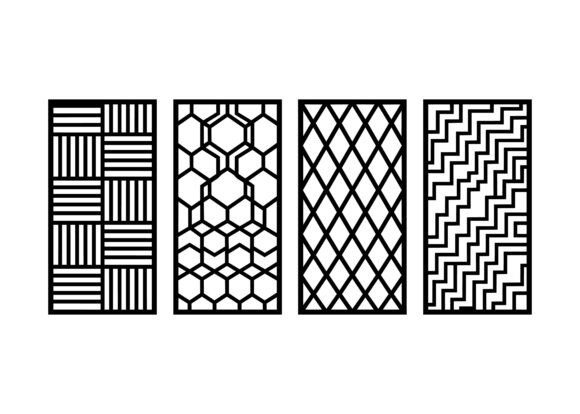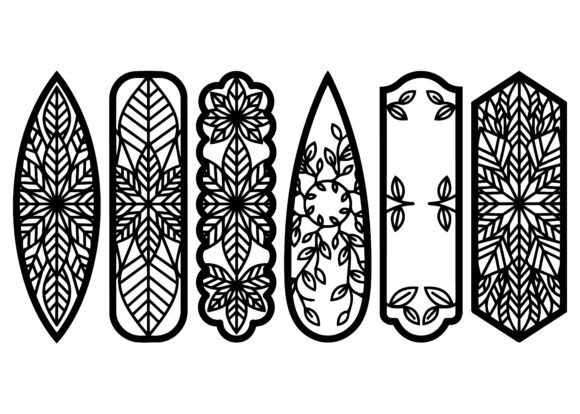
Geometric Leaf Bookmark EPS Bundle
The Geometric Leaf Bookmark EPS Bundle is a curated collection of vector-based digital design files centered on stylized leaf motifs. Each design combines botanical inspiration with precise geometric structure—symmetrical leaf forms intersecting with angular borders, repeating ornamental frameworks, and balanced negative space. Created in Adobe Illustrator and delivered in native EPS format, the bundle emphasizes scalability, clean vector paths, and technical readiness for fabrication processes.
These files are not illustrations intended solely for screen display or print-on-paper use. Rather, they are engineered for physical production: laser cutting, CNC engraving, die-cutting, embossing, and precision craft applications. The vector lines are closed, non-overlapping, and optimized to minimize kerf-related errors during material processing. This makes the Geometric Leaf Bookmark EPS Bundle functionally distinct from decorative PNG or JPEG sets commonly used in graphic design projects.
People typically explore this bundle when evaluating design assets for tangible output—not just visual appeal. Common motivations include launching a small-batch stationery line, developing branded gift tags for retail packaging, producing custom bookmarks for libraries or bookstores, or creating decorative leather or wood accessories. Educators and makerspaces also consider it for teaching vector-based fabrication workflows, where clarity of path construction and material compatibility matter more than stylistic novelty.
One primary benefit lies in its technical consistency. Because all designs are built as single-layer, outline-only vectors with no raster effects or embedded images, users avoid time-consuming cleanup before sending files to machines. The EPS format ensures backward compatibility with older CNC software and laser controllers that do not support newer AI or SVG standards. Additionally, the symmetrical compositions reduce nesting complexity when arranging multiple units on a sheet of material—helpful when optimizing yield for wood, acrylic, leather, or thin metal stock.
However, there are tradeoffs to consider. The emphasis on symmetry and structural clarity means these designs prioritize reproducibility over organic variation. Users seeking hand-drawn texture, subtle asymmetry, or layered tonal depth may find the aesthetic too rigid. Similarly, because the bundle focuses exclusively on leaf-derived geometry, it offers limited motif diversity—no florals, insects, or abstract shapes beyond the core theme. That narrow scope supports cohesion but reduces flexibility for projects requiring broader visual vocabulary.
Material suitability is another practical consideration. While the files work across wood, acrylic, leather, metal, and paper, performance depends on thickness, grain direction, and machine calibration. For example, fine interior cutlines may not translate cleanly to thick hardwoods without adjusting power/speed settings; similarly, thin leather may curl or tear if kerf compensation isn’t applied. Users should verify file dimensions against their machine’s minimum trace width and test cuts on scrap material before full production.
The Geometric Leaf Bookmark EPS Bundle is a strong fit when your goal involves repeatable, scalable fabrication of elegant yet structured botanical elements. It suits makers who value predictable output over expressive experimentation—such as producing uniform bookmark sets for wholesale, designing cohesive tag systems for artisanal product lines, or integrating consistent ornamentation into modular stationery kits. Its clean linework also supports color-filling, foil stamping, or paint-fill techniques where edge definition matters.
Conversely, alternatives may be preferable in several situations. If you need designs with variable stroke weights, gradient meshes, or photorealistic detail, a high-resolution PNG or layered PSD set would offer more rendering options—but at the cost of fabrication readiness. If your workflow relies heavily on SVG-native tools like Cricut Design Space or Silhouette Studio, an SVG-optimized bundle might streamline import steps, though EPS remains broadly compatible. And if your project calls for thematic variety—say, mixing leaves with birds, geometric animals, or calligraphic accents—a broader botanical vector pack could provide greater compositional range, even if individual files require more manual refinement.
Decision-making hinges on three questions: What is the intended output method? What materials will be used? And how important is motif consistency versus stylistic range? If laser cutting bookmarks from 3mm birch plywood is the goal—and you plan to produce 50–200 identical units with minimal post-processing—the Geometric Leaf Bookmark EPS Bundle aligns well. Its precision saves time in pre-production setup and reduces trial-and-error during machine testing. But if you’re prototyping one-of-a-kind pieces using mixed media, or if your design process begins with sketching and evolves iteratively, a more editable format (like layered AI files) or a hand-crafted template might better support creative exploration.
It’s also worth noting that “EPS” here refers to true Encapsulated PostScript—not flattened PDF exports mislabeled as EPS. Buyers should confirm file integrity by opening them in vector software and checking for editable paths, absence of embedded rasters, and proper bounding box alignment. Some vendors deliver EPS files with unnecessary layers or hidden objects; reputable bundles include only production-ready outlines with clearly named artboards.
In summary, the Geometric Leaf Bookmark EPS Bundle serves a specific niche: professionals and serious hobbyists who require technically sound, scalable vector assets for physical making. Its strength lies not in visual novelty alone, but in functional reliability—clean lines, consistent symmetry, and cross-material adaptability. It does not replace illustration skills or design intuition, but rather extends them into the realm of precise fabrication. Evaluating it requires matching its constraints and capabilities to your actual workflow, material choices, and production scale—not just aesthetic preference.
Before purchasing, review sample files if available, test one design in your preferred software, and compare its path structure and sizing against your machine’s requirements. Doing so helps confirm whether the bundle’s focused approach supports your goals—or whether a more flexible or thematically diverse alternative better meets your needs.