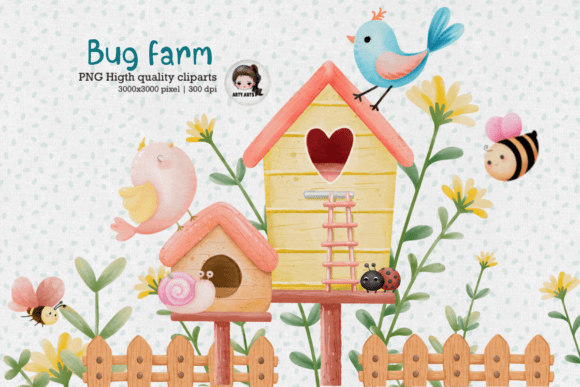
Bugs Farm: A Thoughtful Approach to Playful Digital Assets
Bugs Farm is a curated collection of hand-crafted, personality-driven insect illustrations designed for digital design use—think websites, apps, presentations, social content, and educational materials. Unlike generic clipart or algorithmically generated vector packs, each bug in Bugs Farm is drawn with deliberate attention to expression, posture, and subtle visual storytelling. A ladybug might tilt its head mid-wave; a bumblebee could clutch a tiny flower like a gift; a caterpillar may peek shyly from behind a leaf. These aren’t just bugs—they’re characters with quiet narrative weight.
What Sets Bugs Farm Apart From Other Illustration Resources
Many illustration libraries prioritize scalability, consistency, or stylistic uniformity—but Bugs Farm leans into intentional variation. While some asset sets enforce rigid line weights, identical stroke styles, or strict color palettes across all elements, Bugs Farm embraces gentle inconsistency as part of its charm. One beetle might have watercolor texture; another uses clean flat vectors; a third blends soft gradients with fine ink detailing. This isn’t a flaw—it’s a design choice that supports expressive, human-centered projects where warmth and authenticity matter more than pixel-perfect repetition.
This approach contrasts with icon systems built for interface clarity (where abstraction and standardization are essential) or stock illustration platforms that emphasize volume over cohesion. Bugs Farm doesn’t aim to be exhaustive—it aims to be resonant. You won’t find 200 versions of the same ant, but you will find five ants, each with a different mood, scale, and implied context—making them easier to match to specific messaging needs.
Fitness for Purpose: Where Bugs Farm Fits—and Where It Doesn’t
Bugs Farm excels in contexts where tone, relatability, and emotional resonance support the goal. Educational tools for early learners benefit from its friendly, non-intimidating portrayals. Wellness brands use its grounded, unhurried aesthetic to soften clinical messaging. Indie publishers incorporate Bugs Farm illustrations into children’s e-books or nature-themed newsletters—not as decorative filler, but as visual anchors that reinforce theme and voice.
Conversely, Bugs Farm is less suited for technical documentation, enterprise dashboards, or accessibility-critical interfaces. Its emphasis on nuance means some figures lack the high-contrast definition or standardized sizing needed for WCAG-compliant icons. Similarly, developers building component libraries may find its stylistic flexibility less compatible with automated design system workflows than strictly modular, tokenized icon sets.
A practical example: A science educator creating an interactive module about pollination might choose Bugs Farm to illustrate bee behavior—its expressive eyes and gentle motion lines help students connect emotionally with ecological concepts. But if that same educator were designing a lab safety poster requiring instant recognition and unambiguous visual hierarchy, a simplified, high-contrast insect icon set would likely serve better.
Comparing Approaches: Hand-Crafted Personality vs. Systematic Utility
Illustration resources generally fall along a spectrum between two poles: expressive individuality and functional interchangeability. At one end sit generative AI tools, which produce vast quantities of insect visuals quickly—but often lack coherent style continuity or intentional detail. At the other are rigorously engineered design systems, where every element follows strict grid logic, spacing rules, and semantic naming conventions. Bugs Farm occupies the middle ground: human-made, cohesive enough to feel unified as a family, yet diverse enough to avoid visual fatigue.
This balance has real workflow implications. Designers using Bugs Farm report spending less time editing or stylizing assets before integration—because the expressions and proportions already align with warm, approachable communication goals. There’s no need to soften sharp edges or add blush tones to make a bug “friendly”; it arrives friendly. That saves iteration time without sacrificing creative control.
Realistic Use Cases and Integration Considerations
Bugs Farm assets are delivered in scalable vector formats (SVG, EPS) and high-resolution PNGs, supporting both web and print use. They integrate smoothly into Figma, Adobe Illustrator, and Sketch—though users should note that layered files retain manual grouping rather than auto-generated components. This preserves artistic intent but means minor reorganization may be needed when adapting to strict design system constraints.
For teams evaluating illustration options, consider how much customization your project requires. If your brand guidelines mandate exact hex values, fixed stroke widths, or animation-ready layer separation, you may need to adjust some Bugs Farm files manually—or pair them with a more structured base set. On the other hand, if your team values speed-to-message and visual warmth over granular systemization, Bugs Farm reduces the need for post-import tweaking.
One nonprofit focused on urban gardening used Bugs Farm across their seasonal campaign: SVG beetles anchored email headers, PNG ladybugs appeared as hover states on donation buttons, and layered butterfly illustrations became animated transitions in their explainer video. Their designer noted that the consistency of *tone*—not just style—meant they avoided the disjointed feeling common when mixing assets from multiple sources.
Decision Factors: Questions to Guide Your Choice
- What’s the primary emotional goal? If connection, curiosity, or gentleness matters more than neutrality or urgency, Bugs Farm’s personality-forward approach aligns well.
- How much design system infrastructure do you already have? Teams with mature, token-driven systems may prefer assets built for those constraints—while smaller teams or solo creators often appreciate Bugs Farm’s ready-to-use expressiveness.
- Is scalability across formats critical? Bugs Farm works reliably at common web and presentation sizes, but extreme scaling (e.g., billboard-sized prints or micro-icons under 16px) may reveal subtle textural choices not optimized for those extremes.
- Who is interpreting the visuals? Younger audiences, neurodiverse users, or general consumers often respond well to Bugs Farm’s clear body language and gentle exaggeration—whereas expert or technical audiences may prioritize precision over playfulness.
Not Just Cute—Consistently Considered
The enduring appeal of Bugs Farm lies in its restraint. It avoids infantilizing its subjects while still making them accessible. There’s no exaggerated cuteness for cuteness’ sake—no oversized eyes or comically stubby limbs unless they serve a specific expressive purpose. A praying mantis holds still with quiet focus; a firefly glows with soft, intentional light—not flashy spectacle. This measured approach gives designers room to interpret, adapt, and build meaning around each figure rather than being led by overt visual cues.
That thoughtfulness extends to licensing. Bugs Farm permits broad commercial use—including client work and SaaS applications—without requiring per-project attribution. Still, users should review the current license terms directly, as usage rights can vary by edition or distribution channel. Some collections include extended licenses for merchandise or broadcast, while others are limited to digital and print media.
In summary, Bugs Farm isn’t a replacement for every illustration need—but it fills a distinct and increasingly valuable niche: human-scaled, emotionally intelligent visual language for projects where authenticity and warmth carry measurable impact. When your goal is to invite attention, sustain engagement, or gently guide understanding, its carefully observed bugs offer more than decoration. They offer presence.